Every startup wants to move fast. That’s why Builder.ai took off — it offered a seductive promise: “Launch your app without writing code.” For early founders, that sounds like freedom.
But freedom isn’t just about speed. It’s about control.
Sooner or later, most startups discover that speed without flexibility becomes its own form of lock-in. You can’t adjust your logic, can’t integrate your own AI tools, and can’t evolve your stack. That’s when founders start looking for something better — not just faster, but smarter.
That’s where Vibe Coding by Emveep comes in. It’s a new way to build: AI helps you code, human engineers make it real, and your product evolves as fast as your ideas.
Why Founders Choose Builder.ai (and Why They Outgrow It)

Let’s be fair — Builder.ai exists because it solves a real problem: the skill gap between ideas and code. It empowers non-technical founders to prototype quickly and test assumptions.
But that same simplicity becomes a trap once you need depth.
Startups that survive past their first users hit what I call the integration wall:
- You want to add a custom checkout flow or data sync — but the system doesn’t allow it.
- You try to tweak your logic — but every change costs more.
- You start growing traction — but scaling means rebuilding from scratch.
Builder.ai is great for demos and MVPs that don’t need complex logic.
The problem? Real startups rarely stay simple.
Once your investors, users, or partners demand something unique, you realize you’ve built your business on someone else’s rails.
That’s not innovation. That’s dependency.
How to Evaluate a Real Alternative — The Three F’s Framework
When looking for a Builder.ai alternative, don’t just ask “Which is cheaper?”
Ask “Which one helps me evolve?”
Here’s a mental model used by product-driven founders: the Three F’s — Flexibility, Flow, and Future-proofing.
- Flexibility means the ability to build logic that fits your product, not the other way around. No template should decide how your business works.
- Flow refers to how fast ideas move from conversation to code. In a good system, you’re iterating daily, not submitting support tickets.
- Future-proofing means your foundation can handle 10x growth — technically and strategically. A solid MVP shouldn’t require a total rewrite when you raise your seed round.
Most “AI app builders” handle only the first two weeks of your startup’s life.
You need a partner that helps you reach month six, year one, and beyond.
That’s why many founders are shifting from “no-code” to AI-assisted engineering — a middle path between automation and custom craftsmanship.
Vibe Coding — Where AI Speeds, Engineers Elevate
The principle behind Vibe Coding is simple:
AI should accelerate creation, not replace expertise.
Here’s how it works:
- You describe your idea or “vibe” in natural language — features, flows, and outcomes.
- The AI interprets your intent and generates code scaffolds and UI structures.
- Emveep’s engineers refine it, integrate your stack, and ensure it’s production-grade.
This hybrid model turns AI from a gimmick into leverage.
Instead of being trapped in closed templates, your product is written in open frameworks like Flutter, Next.js, or Node — the same technologies used by serious startups worldwide.
You still move fast, but this time your speed compounds — every new feature builds on a foundation you own.
The Startup Case: From Rebuild to Reinvention
A founder recently came to Emveep after hitting Builder.ai’s ceiling.
Their app was running fine — until they needed dynamic scheduling and AI-driven recommendations. Builder.ai couldn’t support it.
Through Vibe Coding, the team used AI to generate base modules in the first week. Engineers built real integrations with Twilio and Firebase the next. Within four weeks, the MVP was not only live — it was scalable, auditable, and ready for user onboarding.
The founder didn’t just “rebuild” — they reinvented their workflow.
They shifted from waiting on templates to collaborating with engineers, while AI handled all the repetitive work in the background.
That’s the new productivity curve: not faster buttons, but faster iteration loops.
Builder.ai vs Vibe Coding — The Shift from Tools to Teams
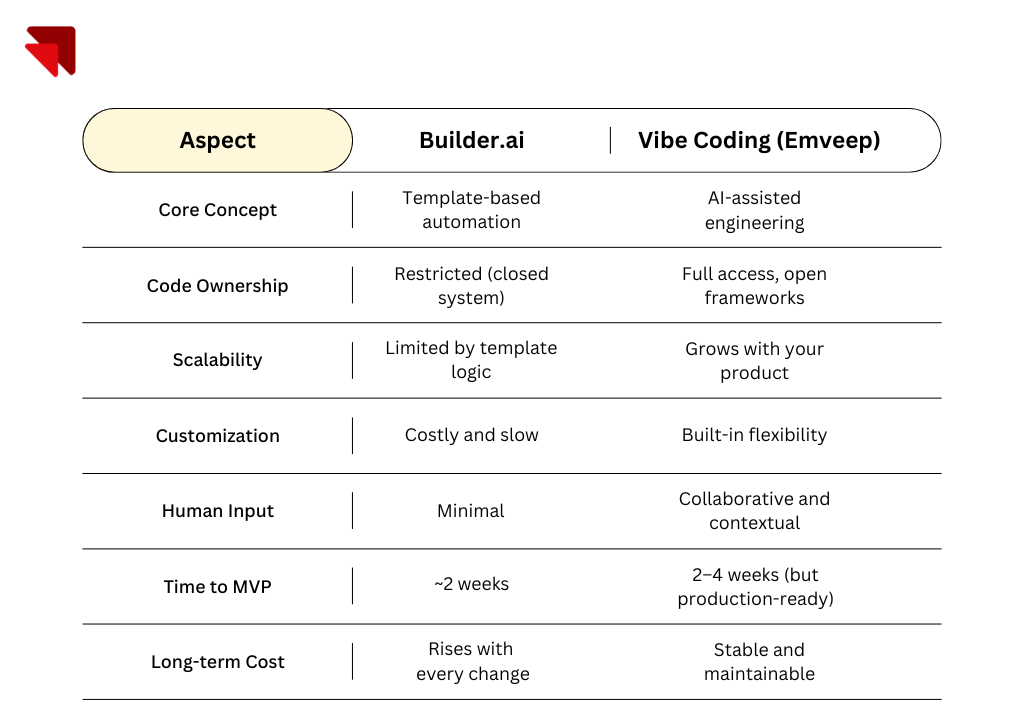
The takeaway: one optimizes for speed at the start, the other for sustainability after launch.
If your startup’s goal is validation only — Builder.ai works.
If your goal is survival — you need Vibe Coding.
When Should You Switch?
Switch when your tool becomes your limit.
The signs are obvious:
- Your roadmap depends on “waiting for support.”
- You’re paying for every modification.
- Your app can’t connect with the tech your users expect.
- Your investor asks, “Can this scale?” and you hesitate.
That’s when you realize you need architecture, not just an app.
The earlier you make that switch, the less time and money you burn on rebuilds.
Build Smarter, Not Just Faster
Builder.ai started a movement: making software creation accessible. But accessibility isn’t the endgame — it’s the doorway.
What comes next is the synthesis of AI and engineering — building systems that learn, adapt, and evolve with your product vision.
That’s what Vibe Coding delivers. It’s not a service. It’s a methodology — one that helps founders launch MVPs that don’t just exist, but scale into companies.
If you’re ready to build with speed, structure, and strategy, explore how Vibe Coding works at Emveep.com.
Related Articles
See more articlesWeb Development
React Js DevelopmentNode Js DevelopmentVue Js DevelopmentNext Js DevelopmentLaravel DevelopmentPython DevelopmentRuby on Rails DevelopmentJava Spring Boot DevelopmentGolang Development.NET DevelopmentHave a question regarding your next project?
If you have any question about us or your next project, don't hesitate to contact us by chat or email.
info@emveep.com