
Quick Overview: AI development companies don’t just build models – they turn your idea plus data into a working product. With 78 % of organizations using AI by 2024 (up from 55 % the year before) and the global AI market projected to grow from US$279 billion in 2024 to US$1.81 trillion by 2030, understanding how these firms operate can unlock serious competitive advantage.
Did you know? More than three‑quarters of organizations now use AI in at least one business function, and 65 % regularly use generative AI. Yet only 22 % have a visible AI strategy – companies with such a strategy are twice as likely to see AI‑driven revenue growth and 3.5 times more likely to achieve critical AI benefits. If you’re wondering whether to hire a team or just wing it with ChatGPT plug‑ins, this data‑backed guide lays out what an AI development company does and when to call one in.
Shortcut: Want to build faster with expert AI engineers? Talk to a team now
Let’s Cut to the Chase: What Do They Actually Do?
An AI development company helps you turn your idea and data into a production‑ready AI solution. Think of it as bringing together a product strategist, data engineer, ML expert and full‑stack dev team in one. Their scope includes:
- Discovery & scoping – clarify use cases, risks, ROI and metrics.
- Data readiness – audit data quality, privacy and governance; build pipelines.
- Solution architecture – choose between prompting, RAG, fine‑tuning or classic ML.
- Product build – develop back‑end APIs and front‑end UX for your AI features.
- MLOps & safety – implement versioning, evaluation pipelines, and guardrails.
- Continuous improvement – collect telemetry, run A/B tests and iteratively improve.
It’s not just about code. 21 % of organizations using generative AI have already redesigned workflows, showing how AI rewiring creates value beyond the model itself.
When Do You Actually Need One?
Hire an AI development company if:
- You need a working MVP in 2–3 months and can’t build an internal team fast enough.
- Your existing team lacks ML/LLM, data engineering or MLOps expertise.
- You want objective guidance on build vs. buy or vendor selection.
Maybe hold off if:
- You only need a CRUD web app (a regular software house will do).
- You have no usable data – start with data collection and governance first.
- You already have a strong internal AI team and just need staff augmentation.
ROI speaks volumes: a 2025 IDC report found that generative AI delivers an average return of 3.7× per dollar invested, with top performers seeing up to 10.3×. Productivity is the biggest driver – 92 % of AI users leverage AI for productivity and 43 % say productivity use cases provide the greatest ROI.
Real Talk: What You’ll Get (Not Just Code)
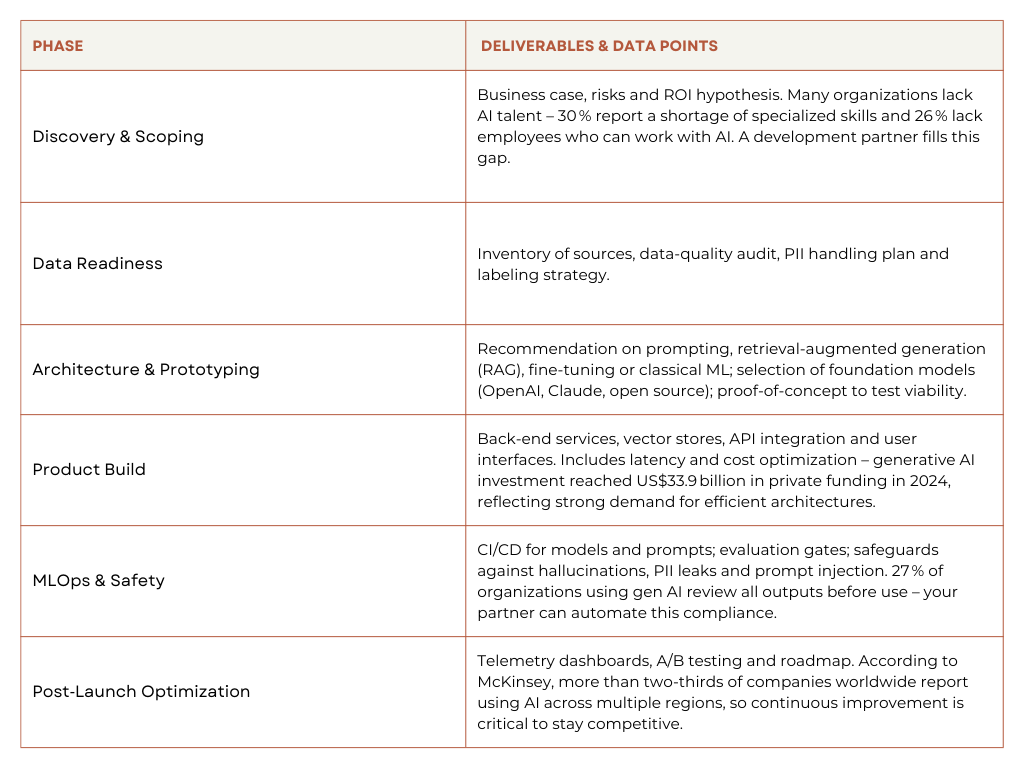
Real‑World Case Studies
- BMW implemented an AI‑powered quality inspection system that cut processing time from 45 seconds to 3.2 seconds while achieving 99.4 % accuracy.
- Eaton used generative AI to automate parts of product design, reducing design time by 87 % and improving quality.
- Mondelez leveraged AI for product formulation and saw development cycles speed up 4–5× and sales rise by 5.4 %.
These examples underscore how AI development companies can drive tangible outcomes – not just prototypes.
Who’s on the Team?
A robust AI development partner brings together:
- AI/ML engineers – model design, evaluation and safety.
- Data engineers – pipelines, retrieval and governance.
- Full‑stack developers – back‑end, front‑end and API integration.
- Product strategists – ensure you’re building the right thing.
- MLOps/SecOps experts – manage CI/CD, monitoring and compliance.
Common Myths (and the Truth)
- “Just plug in ChatGPT and ship it.” Real AI products need data pipelines, evaluation and a polished UX.
- “Prompt engineering is all you need.” In many cases you’ll also need RAG, fine‑tuning and structured data.
- “Once it’s built, we’re done.” Models drift; data changes. AI leaders currently enjoy 3–7 % profit margin advantages, projected to rise to 8–15 % by 2027; sustained improvement matters.
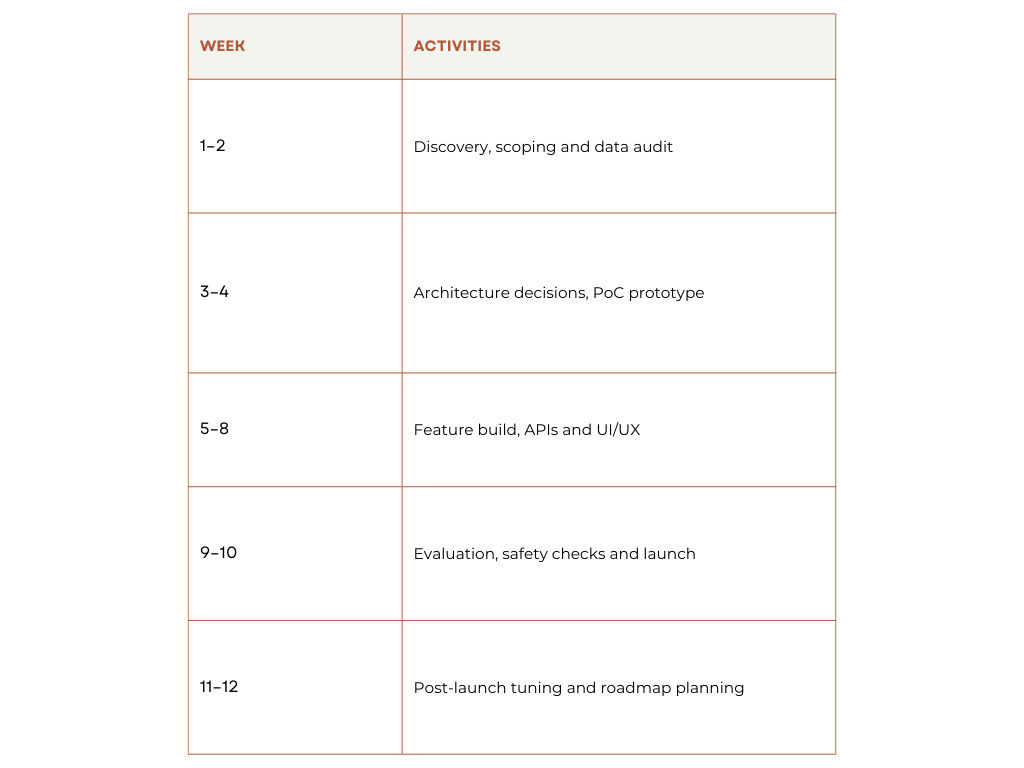
What It Looks Like in Real Life (Typical 10–12 Week Sprint)
So, How Much Does It Cost?
It really depends.
Some AI MVPs are simple and ship in a few weeks. Others need months of data prep, custom integrations, or advanced safety layers. If you’re building something complex (say, with compliance requirements or RAG search), expect more time and coordination.
The truth?
An AI product can be relatively affordable—or seriously expensive. It all comes down to your requirements, your data readiness, and the speed you’re aiming for.
Pro tip: Pick a team that gives you clear deliverables, realistic timelines, and transparency about what you’re not building yet.
If you’re unsure, start with a scoping session. That way, you’ll get clarity on effort, risks, and next steps—before committing to a build.
Final Thoughts
AI development companies are the shortcut to real traction. With 78 % of organizations already using AI and the market set to reach US$1.81 trillion by 2030, the question isn’t whether to adopt AI but how to do it responsibly and profitably. Firms with clear AI strategies are twice as likely to achieve revenue growth from AI. A capable partner can help you craft that strategy, build the right product and manage the talent and risk gaps that hold most companies back.
Ready to turn your AI idea into a live product? Book a discovery call and let us guide you from concept to launch.
FAQs
What’s the difference between AI consulting and an AI development company?
Consultants help with strategy and architecture; development companies design, build and operate AI products – including data engineering, MLOps and ongoing optimization.
Do I need perfect data to start?
No. Many successful AI projects begin with imperfect datasets and include a plan for improving data quality over time.
How is success measured after launch?
Track product metrics (adoption, time‑to‑value), technical metrics (evaluation pass rates, latency SLOs, cost per request) and operational metrics (drift alerts, incidents).
Related Articles
See more articlesWeb Development
React Js DevelopmentNode Js DevelopmentVue Js DevelopmentNext Js DevelopmentLaravel DevelopmentPython DevelopmentRuby on Rails DevelopmentJava Spring Boot DevelopmentGolang Development.NET DevelopmentHave a question regarding your next project?
If you have any question about us or your next project, don't hesitate to contact us by chat or email.
info@emveep.com