Vibe coding goes wrong when AI-generated code moves from fast prototype to real production use without enough review, security, and system ownership
Ready to build faster without building blind? Start your free trial
Vibe coding usually goes wrong when teams move AI-generated code from prototype territory into production before they have added enough judgment, review, structure, and accountability. What breaks is not always the demo. In fact, demos often look great. What breaks is reliability once the software starts dealing with real users, edge cases, permissions, billing logic, changing requirements, and the pressure of ongoing maintenance.
That is why vibe coding can be incredibly useful for prototypes, internal tools, UI scaffolding, and fast experiments, but much riskier when it becomes the hidden foundation for trust-critical systems. The real danger is not that AI always writes bad code. The real danger is that it can make unfinished thinking look finished.
What is vibe coding, really?

Vibe coding is best understood as a way of building where momentum leads and structure follows later, if it follows at all. It usually means using prompts and AI coding tools to get from idea to implementation as quickly as possible, often without the same level of deliberate system design that traditional engineering workflows would demand upfront.
And to be fair, that feeling is not an illusion. For a founder trying to validate an idea, a solo entrepreneur trying to launch without a full team, or a lean product group trying to reduce the time between concept and feedback, vibe coding can be genuinely valuable. It cuts friction. It turns abstract ideas into something visible. It makes experimentation cheaper and faster.
The problem starts when people confuse that early leverage with production readiness.
Why does vibe coding feel so powerful at first?

Part of the appeal is practical, and part of it is psychological.
On the practical side, AI coding tools can accelerate scaffolding, interface work, repetitive implementation, and first-pass product development in ways that would have felt extreme only a short time ago. On the psychological side, the speed changes how people judge progress. Once a product starts to look polished, stakeholders often begin trusting it more than they should. A founder sees an MVP taking shape in days instead of weeks. A product team sees features appearing quickly. A junior developer feels dramatically more capable. An agency sees a path to faster delivery. Everyone feels momentum.
That momentum is real, but it also creates a trap. A working interface can easily be mistaken for a working system. A smooth demo can quietly become evidence, in people’s minds, that the underlying software is already solid.
This is usually the first point where vibe coding starts becoming dangerous. Not when the code looks obviously broken, but when it looks polished enough to earn trust it has not yet earned.
Where does vibe coding work well and where does it break?
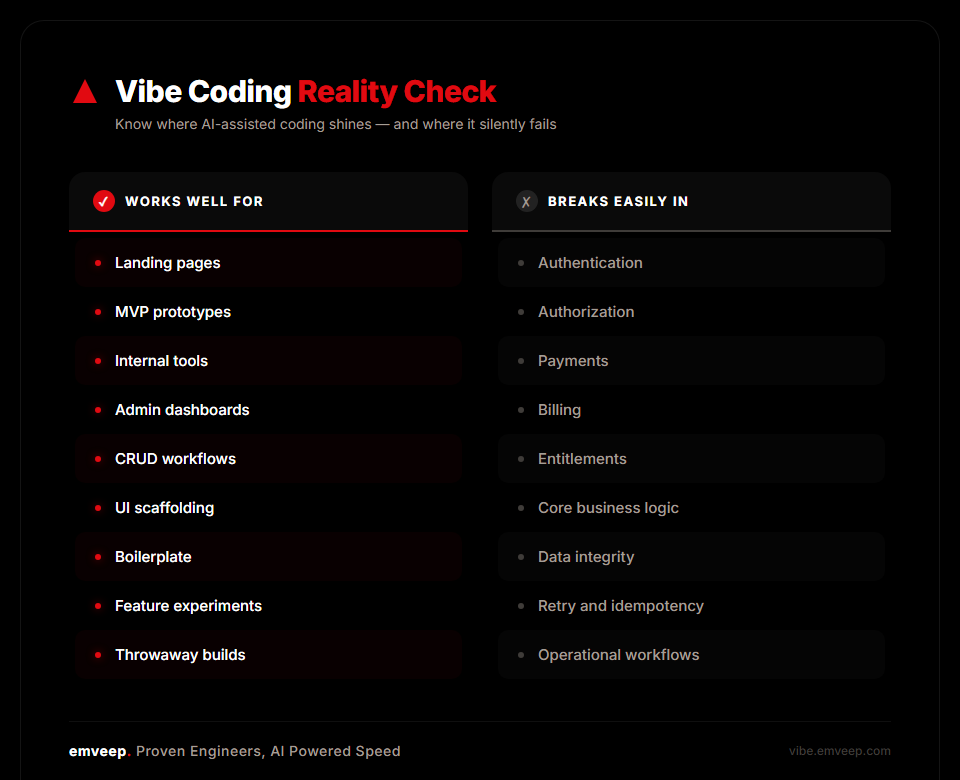
Vibe coding is at its best when the cost of being wrong is low and the value of moving quickly is high. That is why it works so well for prototypes, internal tools, admin dashboards, landing pages, basic CRUD workflows, UI assembly, and lightweight experiments. In those contexts, the goal is often to learn, validate, or unblock momentum rather than to build something that must withstand sustained operational complexity.
The picture changes once the software starts carrying real responsibility. Authentication, authorization, payments, billing, entitlements, core business logic, data integrity, operational workflows, retries, and idempotency are all far less forgiving. A rough internal tool can survive some inconsistency. A billing system cannot. A prototype can get away with structural shortcuts. A real product that needs to evolve safely over time cannot.
Why does AI-generated code fail in production?
What usually fails is not one dramatic snippet. It is the accumulation of local decisions that were good enough in isolation but never shaped into a coherent system.
AI is often strong at solving the task immediately in front of it. It can generate the endpoint, patch the bug, build the form, write the helper, or suggest the query. But production software depends on more than local correctness. It depends on consistency across the whole system: where business logic lives, how data is validated, how state changes are managed, how permissions are enforced, how retries behave, how failures are handled, and how duplicate actions are prevented.
When those decisions are made implicitly by generated output instead of deliberately by the team, the software may still look fine for a while. Then production complexity shows up. A technical founder starts to see architecture drift. Engineers notice duplicated logic and weak system boundaries. Product teams feel the pain as regressions and support tickets. Clients experience the same issue more bluntly: the software looked ready in the demo and less reliable in actual operations. Investors and advisors often see it as a deeper execution problem, where a team can demonstrate velocity but has not yet shown durable control over what it is building.
That is why the most important distinction is not whether AI-generated code works on the happy path. It is whether the team still understands the system as a system.
What are the biggest risks of vibe coding?
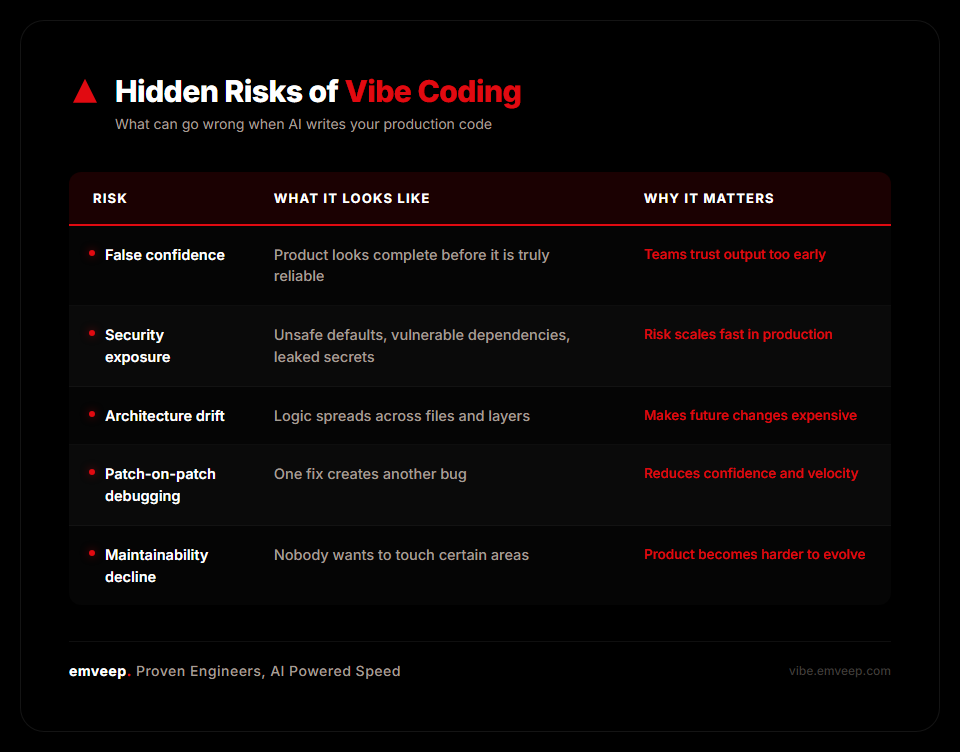
The most dangerous risk is false confidence. Vibe-coded software often looks further along than it really is. The interface is polished, the main flow works, the output feels substantial, and stakeholders naturally assume the underlying system is similarly mature. But output quality and system quality are not the same thing.
From there, the problems tend to compound. Architecture begins to drift because AI is generating local solutions without a strong system-wide frame. Logic ends up duplicated across files and layers. Bug fixing becomes reactive, with one patch creating side effects that lead to the next patch. The codebase starts to develop inconsistent patterns because different prompts, contexts, and generated solutions solve similar problems in different ways. Over time, maintainability suffers, and parts of the system become difficult to touch because nobody fully trusts what changing them will break.
Security risk is another major concern. Those risks become more serious when teams are moving quickly and assuming the code is safer than it has actually been verified to be.
What makes all of this especially dangerous is that vibe coding rarely fails in the most visible place first. It usually fails later, under pressure, in the places where trust matters most.
Who is responsible when AI-generated code goes wrong?
The answer is still humans.
That should be obvious, but one of the subtler effects of vibe coding is that it can weaken the instinct to treat generated code with the same seriousness as manually written code. People start behaving as if the output arrived with some built-in credibility. It did not. AI can accelerate implementation, but it cannot own legal exposure, customer trust, uptime, architectural decay, or the cost of regressions.
That matters across every audience involved in product development. Founders remain responsible when an MVP breaks trust with early users. CTOs remain responsible when architecture debt slows the company down at the exact moment growth begins. Product leaders still own the customer impact of fragility hidden behind a fast roadmap. Agencies still own the outcome when clients inherit a product that looked polished but proves unstable. Developers, junior or senior, are still responsible for understanding the code they merge. If that sense of ownership is weak, the system usually becomes harder to trust much faster than anyone expects.
What are the warning signs that vibe coding is going wrong?
Most teams do not go from fast progress to total failure overnight. The warning signs usually arrive earlier.
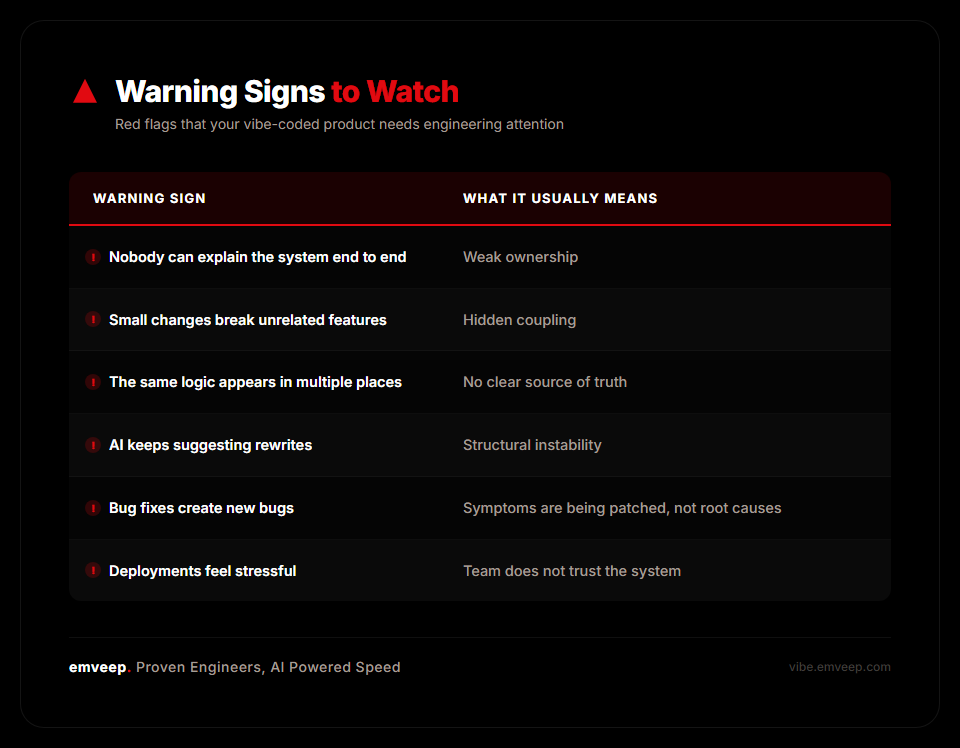
One of the clearest signs is when nobody can explain how the system works end to end without falling back on prompt history or scattered local context. Another is when small changes start breaking features that should have been unrelated. Teams also run into trouble when the same logic exists in multiple places, when bug fixes repeatedly create new bugs, when AI keeps suggesting rewrites instead of clean improvements, or when certain parts of the codebase acquire an informal reputation as places nobody wants to touch.
The pattern can show up in different ways depending on where someone sits. Founders often feel it first as slower iteration. Product teams feel it as rising user friction and support load. Engineers feel it as anxiety around changing code that should have been routine to update. Clients notice repeated issues after launch. Growth teams sometimes see it in the most frustrating form of all: conversion improves, but support requests and operational cleanup rise with it.
Those are not minor annoyances. They are early signals that speed may already have outrun ownership.
What happens when vibe-coded software meets real users?
The pattern is usually easy to recognize once you have seen it once.
A team uses AI tools to build an MVP quickly. The first version looks strong. The onboarding works on the happy path, the dashboard feels polished, and stakeholders are excited because the product appears much further along than expected. The build earns trust early because the visible surface is convincing.
Then real usage begins.
Permissions behave inconsistently. Billing and access fall out of sync. Workflow state changes start failing in awkward sequences. A small fix in one place causes a regression somewhere else because business rules were duplicated in multiple layers. Nobody wants to touch a certain part of the system because it keeps breaking unrelated behavior.
At that point, the product is in the most dangerous state: not broken enough to justify a rewrite, but broken enough to slow the business down.
This is where many teams discover that what felt like speed was, in part, deferred complexity. The software did not collapse. It became expensive to change.
How do you use vibe coding without creating technical debt?
The answer is not to stop using vibe coding. The answer is to stop using it carelessly.
The healthiest way to think about it is as controlled leverage. Use it to accelerate implementation, not to outsource judgment. Let it help with prototypes, internal tools, repetitive work, UI assembly, and fast experimentation. But once software starts touching revenue, permissions, billing, core workflows, or trust-critical operations, the standards need to change.
That means making architecture more deliberate before generation becomes too heavy. It means keeping human review mandatory for critical paths. It means separating prototype mode from production mode so the team is not applying prototype habits to production systems. It means using tests, logging, and observability to verify behavior beyond the happy path. It means maintaining clear ownership so someone can explain and safely evolve each important part of the system. And it means reducing unnecessary variation so the codebase develops stronger consistency instead of becoming a collection of locally correct but globally conflicting solutions.
This is usually where more mature teams separate themselves from teams that are only moving fast. They still use AI. They still benefit from the leverage. But they understand that speed only helps if the product remains understandable, reviewable, and safe to change.
What separates a fast prototype from a reliable product?
Vibe coding is not the problem.
The real problem is what happens when fast output creates the illusion that the underlying system is ready for trust, scale, and change.
AI can absolutely help founders launch faster, help entrepreneurs validate ideas, help product teams move with more momentum, and help engineers eliminate repetitive work. But it cannot maintain the system later, and it cannot carry responsibility for what ships. That part still belongs to the humans building, reviewing, and operating the product.
So the real question is not whether AI helped your team move quickly.
The real question is whether your team still understands, owns, and can safely evolve what was shipped.
If the answer is no, then vibe coding is no longer accelerating your product. It is quietly accumulating technical debt behind a polished interface.
Start building faster without building blind
Move from idea to product faster, without turning speed into hidden technical debt. See how structured AI-assisted product building helps teams prototype quickly, ship with more confidence, and stay in control as complexity grows.
Ready to see what structured AI-assisted product building looks like in practice? Start your free trial.
FAQ
What is vibe coding?
Vibe coding is a fast, AI-assisted way of building software where prompts and generated code help teams move quickly from idea to implementation. It works especially well for prototypes, internal tools, and early product experiments, but it becomes riskier when teams treat that same speed as proof of production readiness.
Why does vibe coding go wrong?
Vibe coding usually goes wrong when AI-generated code moves into production before the team has added enough review, architecture, testing, and ownership. The biggest problem is not bad demos. It is fragile software that looks finished before it is truly reliable, secure, or easy to maintain.
Is AI-generated code safe for production?
AI-generated code can be used in production, but it should not be trusted by default. It needs human review, clear system boundaries, testing, observability, and stronger engineering discipline, especially in areas like billing, authentication, permissions, and core business logic.
Where does vibe coding work best?
Vibe coding works best in low-risk, high-speed use cases such as MVP prototypes, internal tools, landing pages, UI scaffolding, admin dashboards, and feature experiments. These are situations where learning fast matters more than long-term system complexity.
What are the biggest risks of vibe coding?
The biggest risks are false confidence, security exposure, architecture drift, patch-on-patch debugging, and declining maintainability. These issues often stay hidden early on, then become expensive once the product starts handling real users and real operational pressure.
What are the warning signs that vibe coding is going wrong?
Common warning signs include code nobody can fully explain, small changes breaking unrelated features, duplicated logic across the system, repeated bug-fix regressions, constant rewrite suggestions from AI, and deployments that feel increasingly stressful.
Who is responsible for AI-generated code?
The team shipping the product is still responsible. AI can accelerate implementation, but it cannot own the quality, security, maintainability, or business consequences of what goes into production.
How do you use vibe coding without creating technical debt?
The safest approach is to use vibe coding as an accelerator, not a substitute for engineering judgment. That means using it heavily for prototypes and repetitive implementation, while keeping human review, architecture decisions, testing, and production guardrails in place for critical systems.
Related Articles
See more articlesWeb Development
React Js DevelopmentNode Js DevelopmentVue Js DevelopmentNext Js DevelopmentLaravel DevelopmentPython DevelopmentRuby on Rails DevelopmentJava Spring Boot DevelopmentGolang Development.NET DevelopmentHave a question regarding your next project?
If you have any question about us or your next project, don't hesitate to contact us by chat or email.
info@emveep.com