
Key takeaway: This guide helps non-technical startup founders choose the right startup development company partner to turn their ideas into real products. It explains the types of services to expect from a startup development company, including MVP development and CTO-as-a-Service, and offers clear criteria for selecting the right partner.
Many startups fail not because of bad ideas, but because they choose the wrong startup development company.
Most startup founders do not really dive deep into what really matters in choosing a startup development company. Whereas in IT product development, it is important to have people who are really experts and understand IT architecture, quality development, so that it produces ready-to-use IT products.
At Emveep, when a client chooses Emveep as their startup development company partner, the initial meeting with our clients is something that is very important. Because there we can really understand what is wanted, then can provide solutions based on our experience.
It is not uncommon to find other startup development companies that do not provide significant solutions and have a positive impact in the long term. Remember, your IT product will be a long-term investment, make sure that you choose the right startup development company.
This is a guide in choosing a startup development company by Emveep version, which is really designed based on our experience, to provide the right direction for early-stage and non-technical founders.
Invest in Quality and Delivery by Startup Development Company
For non-technical founders, it’s easy to be swayed by flashy portfolios or cheap prices. But IT product development is not just about building fast — it’s about building well. That means having a partner who understands software architecture, writes maintainable code, follows proven development processes, and is honest when giving feedback about your product roadmap.
At Emveep, we see product development as a partnership, not a transaction. That’s why the first thing we do is sit down with founders to map out their vision. Not just what they want to build — but why they want to build it, what problem they’re solving, and how that solution fits into the bigger picture.
Many founders don’t realize that working with the wrong development company can cost more in the long run. Poorly built products are hard to maintain, difficult to scale, and eventually need to be rebuilt from scratch.
Have a Great Communication and Collaboration Teams
Good communication is often the key factor in a project’s success. Pay attention to their responsiveness and clarity from your first interaction. If the dev team is slow to reply or unclear upfront, collaboration may suffer later on. They should use language you understand, not drown you in technical jargon.
Choose partners who follow iterative processes (like Agile methodology). The Agile Manifesto emphasizes “customer collaboration over contract negotiation” and “responding to change over following a plan.” The best startup developers will actively involve you in every product iteration—not just passively follow static instructions. As Horizon Labs exemplifies, the best teams work closely with founders to define and prioritize core features. This collaborative approach ensures no important ideas are missed and that development stays flexible according to user needs.
Also, make sure there’s proper technical documentation. As your startup grows, good documentation makes onboarding new team members easier and supports future feature updates. In short, open communication and structured collaboration (with regular meetings, daily or weekly updates, and sprint demos) are vital for non-tech founders to stay involved throughout the technical journey.
Understand Their Service Models and Working Methods
Each startup development provider operates under different models. You’ll find traditional agencies, startup studios, and CTO-as-a-Service offerings. Here’s a summarizing their key traits:
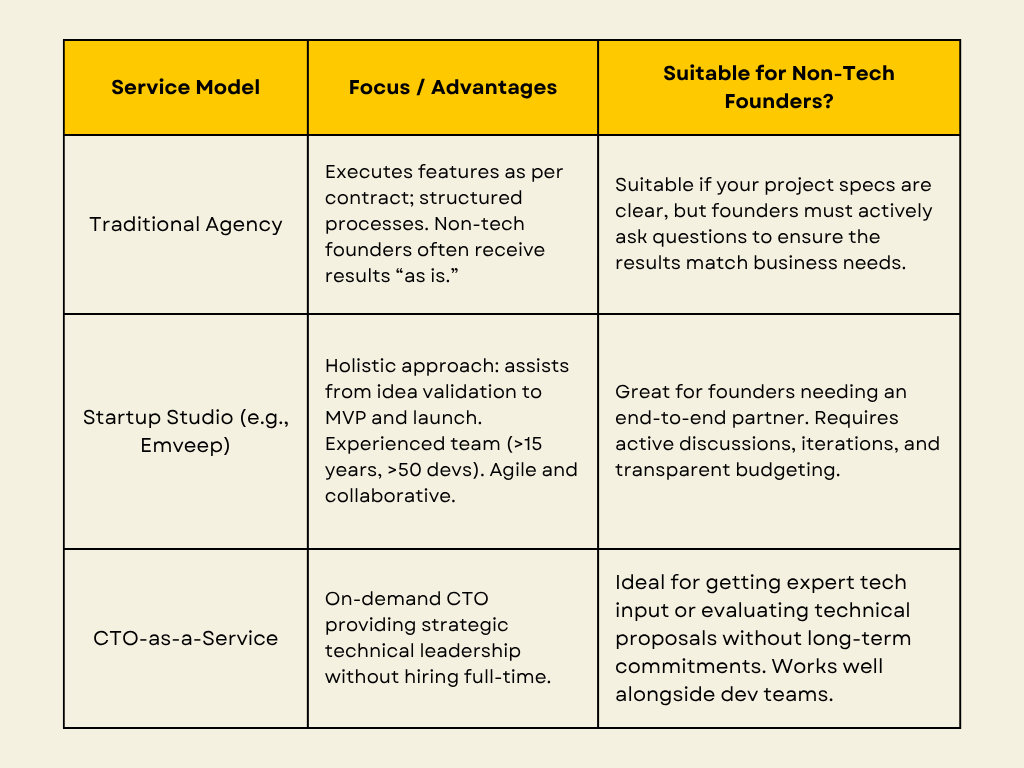
For example, Emveep applies the startup studio model, providing comprehensive MVP development and infrastructure setup, while keeping costs efficient. If your partner is a traditional software house, assess whether they can also act as a strategic partner, not just a coding vendor. Meanwhile, CTO-as-a-Service can fill technical gaps with expert guidance throughout your project.
Review Portfolios, Case Studies, and Testimonials
Non-technical founders need to assess a development team’s capabilities through their previous work. Ask for demos or access to completed products (if not bound by NDAs). This lets you judge the quality and completeness of their deliverables. Also, study their published case studies: have they built apps similar to your idea? How successful were those products according to their reports?
Check client testimonials and reviews too. Platforms like Clutch or official websites are good sources of feedback. Look for verified reviews that mention both strengths and areas for improvement. If possible, reach out to former clients to get firsthand insights about the collaboration. This gives you a better sense of what it’s actually like to work with that team.
Leverage External Technical Support When Needed
As a non-technical founder, you don’t need to master every aspect of tech development. Many startup development companies now offer additional services—one of the most useful being CTO-as-a-Service. With this, startups can work with an experienced Chief Technology Officer on a flexible basis, without hiring full-time staff. You simply pay for consultation and project oversight as required.
This service is especially helpful for evaluating technical proposals, selecting the right tech stack, and shaping your product roadmap. For example, Emveep is known to offer a CTO-as-a-Service model that helps non-technical founders make strategic decisions without the cost of hiring a permanent CTO. The core idea is providing access to technology leadership with budget flexibility (pay as you go, based on project needs).
Look for Added Value and Competitive Advantages
Every startup development company brings different added values beyond just coding. Make sure your partner isn’t just writing code—they should also bring business insight, innovative methodologies, or cutting-edge tech expertise. Some teams specialize in domains like AI or machine learning to help accelerate your product’s growth. For instance, Emveep emphasizes AI integration in development processes to deliver faster, scalable solutions.
Ask about their quality assurance (QA) process and product scalability readiness. If an offer seems too cheap, it may come at the expense of quality. Compare upfront costs to long-term value: while experienced teams might charge more initially, they usually deliver cleaner, more maintainable code. Remember, your future features will likely evolve based on market feedback—ensure the initial codebase supports future development smoothly.
Frequently Asked Questions (FAQ)
Q: I’m a solo non-tech founder. Can I still build a great startup product?
A: Absolutely. Many solo non-technical founders succeed by partnering with the right development company. Choose a team that offers strategic guidance (not just coding), and consider adding CTO-as-a-Service for critical decisions.
Q: What’s the difference between a software agency and a startup studio?
A: Agencies typically build what you ask for. Startup studios (like Emveep) work with you from validating the idea to launching and scaling. Studios tend to be more collaborative and aligned with startup success.
Q: Do I need to know programming or technical details?
A: No, but it helps to understand key concepts. Focus on communicating your vision clearly. Good partners will help translate your goals into technical action plans and guide you through key decisions.
Q: What if I already have developers but need tech leadership?
A: That’s where CTO-as-a-Service fits perfectly. It supplements your existing development team with strategic oversight and guidance, without hiring a permanent CTO.
Q: Why shouldn’t I just pick the cheapest option?
A: Cheap development often leads to poor architecture, bugs, and technical debt—which can cost much more to fix later. Always balance cost with long-term value and partner experience.
Conclusion
In short, early-stage non-technical founders should carefully select a global development partner by following these steps:
- Understand the service model: Know the difference between traditional agencies, startup studios, and CTO-as-a-Service providers. The table above is your guide.
- Evaluate past performance: Request demos, study case studies, and read reviews.
- Check communication quality: Ensure the team is responsive and follows collaborative Agile processes.
- Use external CTOs if needed: CTO-as-a-Service can provide valuable technical guidance.
- Seek added value: Choose partners with industry experience, innovative approaches, and future-proof development practices.
With this approach, non-tech founders can confidently choose the right global startup development company. For instance, Emveep, listed among the Top Startup Development Companies in 2025, combines CTO-as-a-Service, expert teams, and collaborative Agile processes. Hopefully, these tips help you build a strategic and successful tech partnership for your startup journey.
Related Articles
See more articlesWeb Development
React Js DevelopmentNode Js DevelopmentVue Js DevelopmentNext Js DevelopmentLaravel DevelopmentPython DevelopmentRuby on Rails DevelopmentJava Spring Boot DevelopmentGolang Development.NET DevelopmentHave a question regarding your next project?
If you have any question about us or your next project, don't hesitate to contact us by chat or email.
info@emveep.com