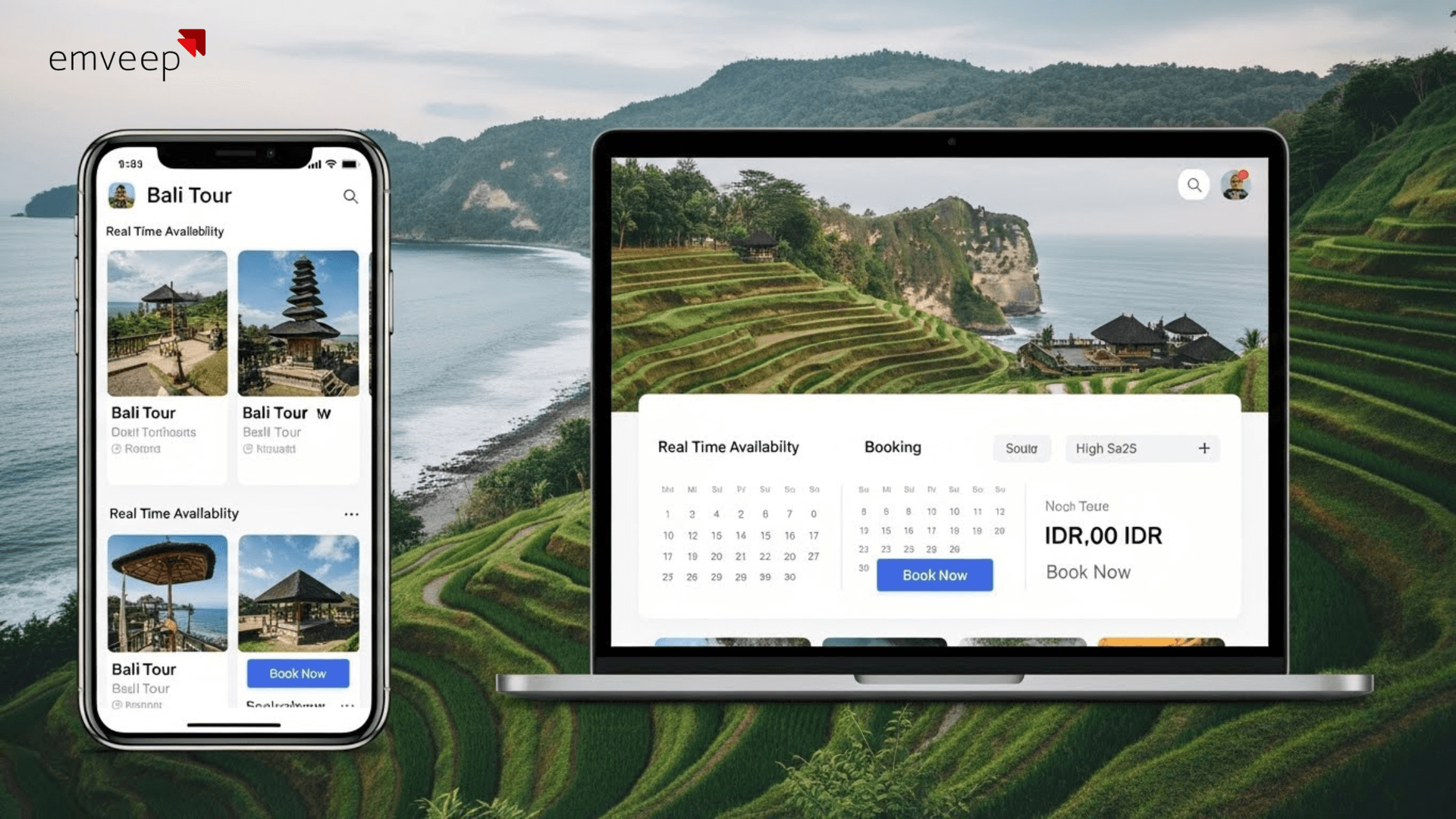
If your current “system” is WhatsApp → Google Sheets → manual confirmations, you’re not alone. Bali tourism demand is still strong (Ngurah Rai Airport reported 4,806,333 foreign tourists arriving by air from Jan–Aug 2025, up 12.4% YoY).
That volume creates one predictable problem: DM chaos.
Also: if you’re operating in Bali, payments + messaging matter a lot. In Indonesia, digital payments hit 3.5B transactions in January 2025 (+35.3% YoY), and QRIS transaction volume grew 170.1% YoY. And WhatsApp is basically the default channel—We Are Social reports 9 in 10 Indonesians are active on WhatsApp monthly.
So the goal for your website isn’t “fancy tech.” It’s this:
Fewer chats. Fewer mistakes. More confirmed bookings.
A travel website should include mobile-first UX, clear pricing, and trust signals
If you sell tours, people decide fast. Your website should help them answer “Can I do this? How much? When? How do I book?” in under a minute.
1) Mobile-first pages that load fast
Most travelers are browsing on phones. Your tour pages must be:
- Thumb-friendly (big buttons, short forms)
- Fast-loading images (compressed)
- “Book Now” always visible (sticky button on mobile)
2) Tour pages that feel like a “decision page,” not a brochure
Each tour page needs:
- Clear itinerary (what happens + duration)
- Pickup/meeting point clarity (Bali-specific: beach clubs, hotel pickup zones, Ubud meeting points)
- What’s included / excluded (gear, meals, entry tickets)
- What to bring + safety notes (especially water sports, trekking)
3) Search + filters that match real Bali buying behavior
Use filters that reflect how tourists actually choose Bali activities:
- Location (Ubud / Uluwatu / Nusa Penida / Canggu / Seminyak)
- Start time (sunrise / morning / sunset)
- Private vs group
- Family-friendly
- “Instagrammable” / photo spots (yes, it matters)
4) Trust signals that reduce “Is this legit?” anxiety
For Bali tour operators selling to international customers, trust is the conversion engine:
- Reviews + ratings
- Real photos (not stock)
- Clear cancellation terms
- “Licensed/insured” indicators (if applicable)
- WhatsApp contact button (because they’ll still ask things)
Pro tip for reviews: Booking.com keeps trust high by controlling review authenticity (they state you can only review a place booked through their platform, and they use automated systems to detect fake reviews). Borrow the principle: let people review only if they booked (e.g., via booking code).
AI upgrades (optional but high ROI)
- AI-powered FAQ widget on tour pages (answers: pickup, weather policy, kid policy, what to wear)
- AI translation helper (English ↔ Bahasa) for FAQs and customer questions
- AI-generated “tour highlights” summary (turn long itineraries into skimmable bullets)
If you don’t have in-house engineers, this is exactly where partnering with an experienced AI development company can help you ship fast without overbuilding.
A good tour booking website must support real-time availability, deposits, and WhatsApp confirmations
This is where most Bali tour websites fail. They look nice… but the booking process is basically “chat us.”
Here’s what you actually need.
1) Real-time availability that blocks slots automatically
If you don’t want double bookings, you need inventory rules:
- Capacity per day/time slot
- Cutoff rules (e.g., “book at least 12 hours before start”)
- Automatic slot closure when full
This replaces the “check sheet → reply manually” loop.
2) Deposits + partial payment
Your booking flow should support:
- Deposit option (e.g., 20–50%)
- Remaining balance instructions (pay later / pay on arrival / pay via link)
- Automatic reminders before tour day
3) Payment methods that match Indonesia + international travelers
For Bali, the best setup is:
- Cards for international guests
- QRIS for domestic guests + local payments (because it’s everywhere)
- Bank transfer/virtual account (optional)
Bank Indonesia highlighted QRIS growth (+170.1% YoY transaction volume growth in Jan 2025). And BI Governor noted QRIS reached 57 million users (reported by Antara). So yeah: supporting QRIS is not a “nice-to-have.”
4) Automated confirmations + reminders
Your booking system should auto-send:
- Confirmation message
- Pickup details + map link
- “What to bring”
- Reminder 24h before
And you want it in WhatsApp-style language, because that’s how people actually read it.
Also, Bali travel now includes extra “admin” for tourists (like the official Tourist Levy IDR 150,000 via Love Bali). You can reduce guest confusion by including a simple note/link in confirmations (especially for foreigners).
AI upgrades (where AI actually helps, not gimmicks)
- AI agent that converts “Is this available tomorrow?” into a booking link with the correct date/time pre-filled
- AI that detects intent (“family of 4”, “private tour”, “need pickup in Canggu”) and routes the right response
- AI upsell suggestions at checkout (“Add snorkel gear rental”, “Add photographer”, “Upgrade to private driver”)
Booking.com succeeds because it reduces risk and friction with reviews, transparency, and policies
You’re not trying to become Booking.com. But you can steal the parts that make them convert like crazy.
What to copy (for a Bali tour operator website)
- Clear policies (refund/cancel rules visible before payment)
- Transparent pricing (no surprise fees)
- Reviews that feel trustworthy
- Filters that make choosing easy
- Fast booking flow (no “wait for admin confirmation”)
Booking.com explicitly explains how their review system works and that they use fraud detection systems to remove fake reviews. That’s a huge trust lever.
Tour-operator backend features that save your life
This is the “I need something that works tomorrow” part:
- Simple admin dashboard (not a complex ERP)
- Upcoming bookings list
- Capacity left per day/tour
- Export to Google Sheets (if your staff still wants it)
- Staff roles (owner vs admin vs guide)
- Booking edits (reschedule, cancel, partial refunds)
- Guide assignment (who handles which trip)
AI upgrades for ops
- AI that flags risky patterns (spam bookings, repeated cancellations, suspicious card attempts)
- AI-generated daily ops summary: “Tomorrow: 3 bookings Ubud tour, 2 bookings surf lesson. 1 guest requested vegetarian meal.”
The 4 P’s of travel are Product, Price, Place, and Promotion
This is the marketing part, but keep it practical:
Product
Your tours need “product packaging” on-site:
- Bundle options (Ubud day tour + coffee plantation + waterfall)
- Add-ons (photographer, lunch, private pickup)
Price
Let yourself run promos without redesigning pages:
- Coupon codes
- Seasonal pricing
- Group discounts
Place
“Where people book you”:
- Direct website bookings (best margin)
- Optional OTA integrations later (don’t start here unless you must)
Promotion
Your site should support:
- SEO blog content (“Best sunrise hikes in Bali”)
- Tracking links for influencers
- Email/WhatsApp remarketing for abandoned bookings
The 7 C’s checklist for Bali tour booking websites: make it clear, credible, and conversion-first
If we translate the “7 C’s” mindset into a tour operator reality, your site needs:
- Clear: no confusing steps
- Credible: trust + reviews + policies
- Connected: payment + WhatsApp + calendar sync
- Consistent: same info everywhere (no “website says 7AM, WhatsApp says 8AM”)
- Compliant: privacy policy + secure checkout
- Care: support that’s easy to access
- Conversion-ready: track what’s working
Bali-specific support features people ignore
- Local entry/tourism info in confirmation messages (like official tourist levy basics and where to pay)
- “What’s included” clarity (many complaints come from mismatch expectations)
- Weather policy page (because Bali conditions affect tours)
AI support upgrades
- AI chatbot trained on your actual tour FAQs
- Auto-translation for support (English ↔ Bahasa)
- AI that summarizes long customer chats into clean booking notes for staff
To create a Bali tour booking site fast: build the MVP first, then add AI and extras
Here’s the “no overbuilding” plan for Persona 1:
Phase 1 (MVP that works immediately)
- Tour pages + mobile-first UX
- Real-time availability + slot blocking
- Deposits + payments (cards + QRIS)
- Auto confirmations + reminders (WhatsApp + email)
- Simple admin dashboard + booking export
Phase 2 (Scale + reduce admin even more)
- Review system with verification logic
- Promo codes + upsells
- Analytics events (who clicks Book Now, where they drop)
- Multilingual support improvements
Phase 3 (AI layer)
- AI chat concierge on website + WhatsApp
- AI lead qualification + intent routing
- AI upsell recommendations + personalized bundles
FAQ
Can customers book and pay deposits online?
Yes and you should. Deposits reduce no-shows, and your flow should support deposit + reminder + balance collection.
How do I avoid double bookings?
Stop relying on Sheets as the source of truth. Your booking engine must be the inventory owner and auto-block slots.
Can I connect bookings to WhatsApp automatically?”
Yes, confirmations, reminders, and pre-trip info can be automated via WhatsApp-style messaging flows (even if you start simple with click-to-WhatsApp + templates, then upgrade to API later). WhatsApp is dominant locally, with 9 in 10 Indonesians active monthly.
Ready to Turn WhatsApp Chaos Into Confirmed Bookings?
If you’re done juggling chats, spreadsheets, and manual confirmations, it’s time to switch to a booking system that actually works for Bali tour operators.
Emveep helps you build a mobile-first tour booking website with real-time availability, deposits, WhatsApp-style confirmations, and optional AI automation without overengineering.
Start with an MVP that works tomorrow. Scale with AI when you’re ready.
Build your tour booking system with Emveep
Related Articles
See more articlesWeb Development
React Js DevelopmentNode Js DevelopmentVue Js DevelopmentNext Js DevelopmentLaravel DevelopmentPython DevelopmentRuby on Rails DevelopmentJava Spring Boot DevelopmentGolang Development.NET DevelopmentHave a question regarding your next project?
If you have any question about us or your next project, don't hesitate to contact us by chat or email.
info@emveep.com