Vibe coding is changing how startup ideas move from “just an idea” to something people can actually click, test, and react to.
For founders, this is a big deal.
In the past, building even a simple prototype usually meant hiring developers, writing a long technical spec, waiting for design handoff, and spending weeks before users could touch anything real.
Now, AI-assisted development makes it possible to describe what you want in plain language and generate working software much faster.
That is the promise of vibe coding.
But here is the part founders need to understand clearly: vibe coding can help you move fast, but it does not remove the need for product thinking, technical review, security awareness, and engineering judgment.
This guide explains what vibe coding means, why startups care about it, where it helps, where it gets risky, and how founders can use it to validate ideas faster without falling into the “working demo equals real product” trap.
What Is Vibe Coding?
Vibe coding is a way of creating software by describing what you want to an AI system using natural language, then letting the AI generate code, screens, logic, or app functionality.
Merriam-Webster defines vibe coding as the practice of using an artificial intelligence system to generate computer code in a programming language. It also notes that non-technologists can now use vibe coding to develop apps by typing prompts into AI models. (Merriam-Webster)
Collins Dictionary named “vibe coding” its 2025 Word of the Year and described it as an emerging software development practice that turns natural language into computer code using AI. (Collins Dictionary)
In simple founder terms:
Vibe coding means using AI to help turn your product idea into working software by describing what you want, instead of manually writing every line of code yourself.
That can include:
- Creating a landing page
- Building a clickable dashboard
- Generating frontend components
- Connecting simple backend logic
- Testing feature ideas
- Creating a prototype users can interact with
For startups, the biggest value is speed. You can move from idea to prototype faster, which means you can start learning from real users earlier.
Why Is Everyone Talking About Vibe Coding Now?
Vibe coding became popular because AI coding assistants and AI agents are getting much better at understanding product intent, generating usable code, and helping people build apps without traditional programming workflows.
The term was popularized by Andrej Karpathy, former Director of AI at Tesla and a founding engineer at OpenAI, according to Collins Dictionary. (Collins Dictionary)
GitHub’s 2025 Octoverse report also points to a broader shift in software development, with AI and agentic workflows driving rapid prototyping, experimentation, and changes in how developers build software. (The State of the Octoverse)
But the adoption is not universal yet. Stack Overflow’s 2025 Developer Survey found that many developers still do not use AI agents regularly, and a significant portion have no plans to adopt them. (Stack Overflow)
So the honest version is this:
Vibe coding is not magic. It is not replacing software engineering completely. But it is becoming a serious workflow for early prototyping, experimentation, and product validation.
For startups, that is already enough to matter.
Why Vibe Coding Matters for Startups
Startups do not fail because they cannot write code.
They often fail because they build the wrong thing, too slowly, with too much upfront cost.
This is where vibe coding becomes useful.
It helps founders reduce the gap between idea and user feedback.
Instead of spending months debating features, founders can create a working prototype, put it in front of users, and see what happens.
That means faster answers to questions like:
- Do users understand the product?
- Does the core flow make sense?
- Is this problem painful enough?
- Would someone actually click, sign up, request access, or pay?
- Which features matter, and which ones are just founder imagination?
For early-stage startups, learning speed is a huge advantage.
A prototype does not need to be perfect. It needs to make the idea real enough for people to react.
That is why vibe coding works best when it is used for validation, not blind production deployment.
Vibe Coding vs Traditional Development
Traditional software development usually starts with requirements, architecture, design, development, testing, deployment, and iteration.
Vibe coding starts with intent.
You describe the result you want, and the AI helps generate the first version.
Here is the practical difference:
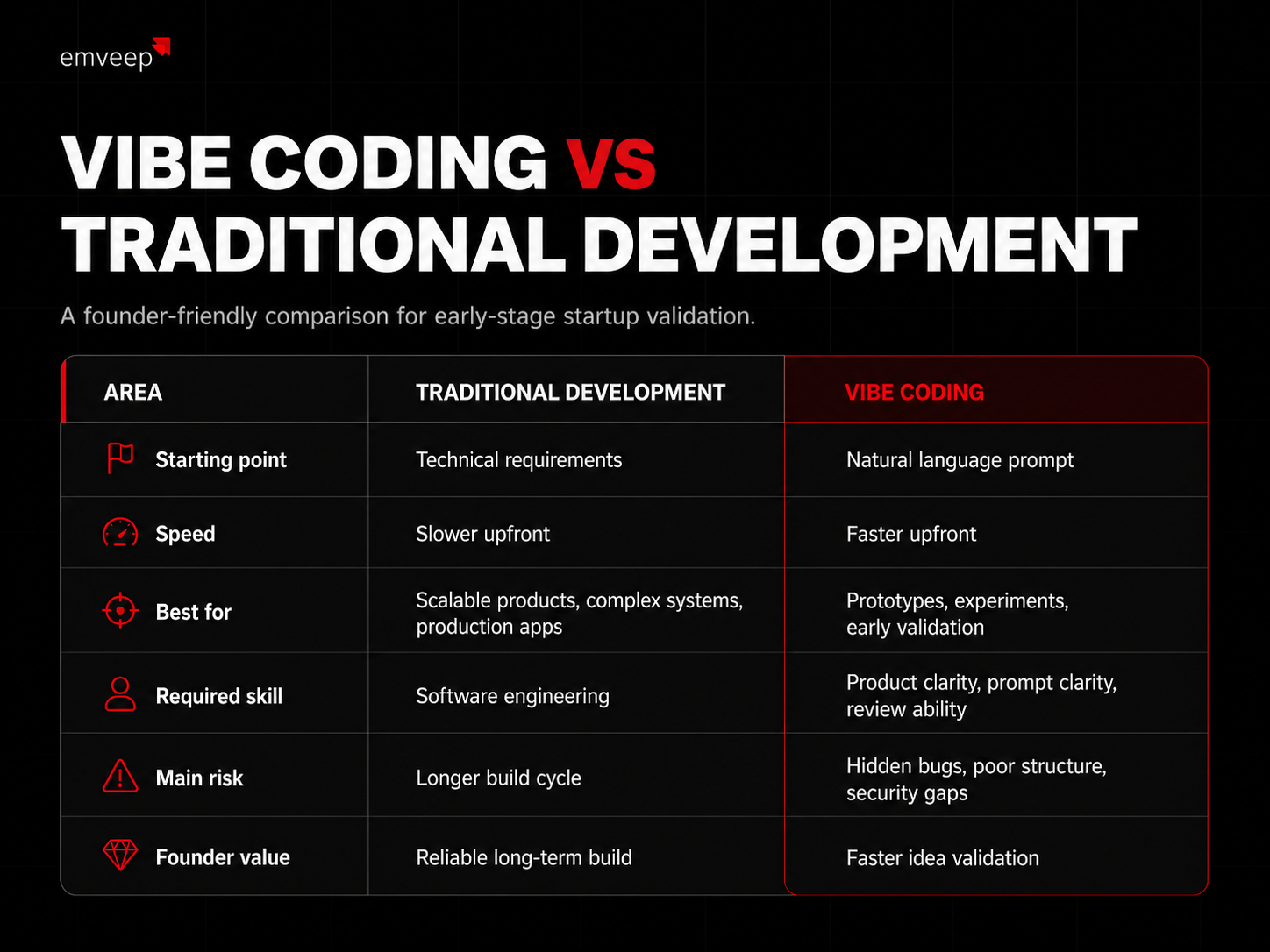 For startups, the smart move is not choosing one forever.
The smart move is using vibe coding for early speed, then bringing in engineering judgment when the idea deserves to become a real product.
Vibe Coding vs No-Code
Vibe coding and no-code are similar because both help non-technical people build faster. But they are not the same.
No-code platforms usually give you visual builders, templates, and predefined logic. You build inside the platform’s system.
Vibe coding uses AI to generate code or app behavior based on natural language instructions.
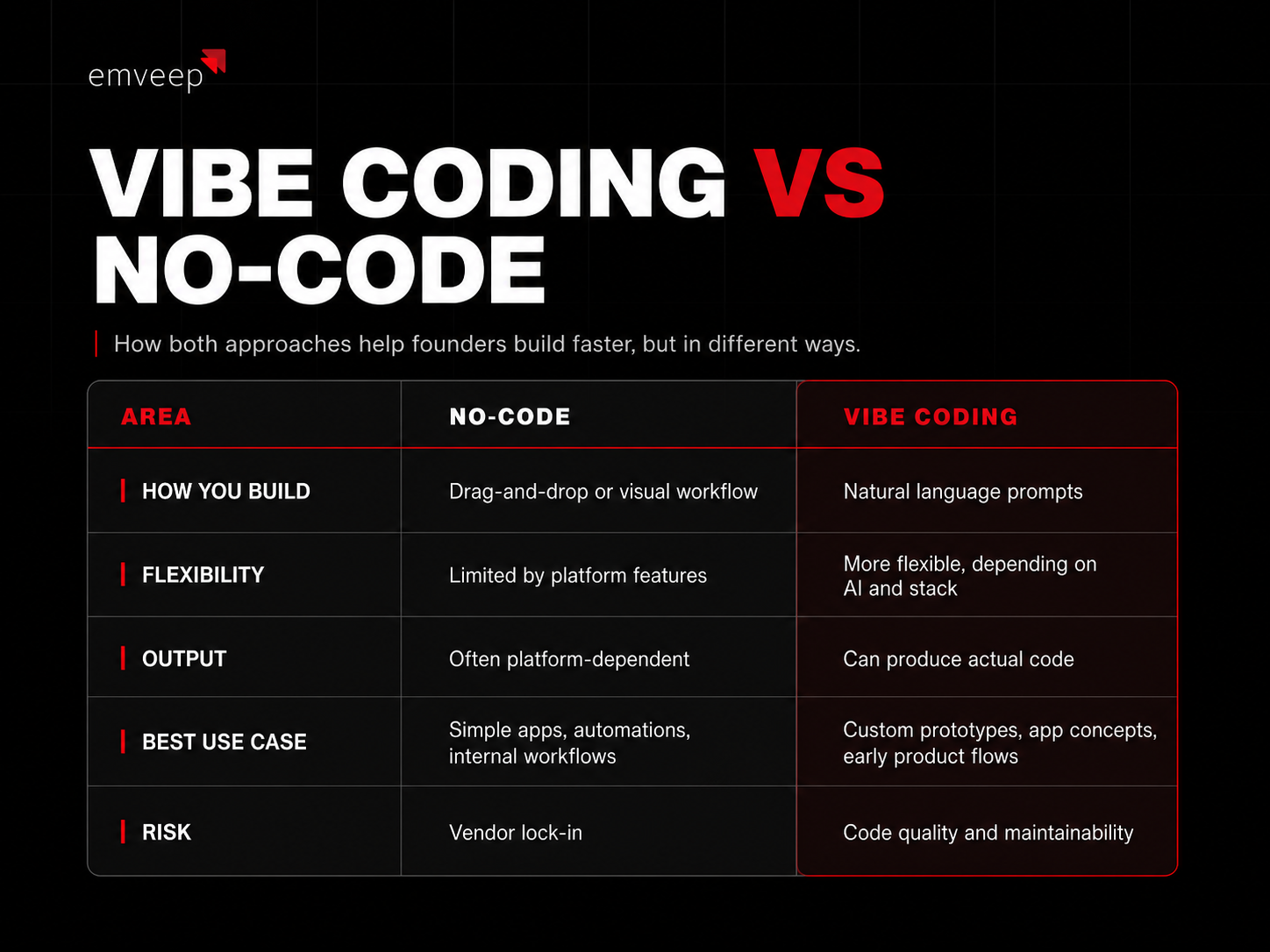 For founders, no-code can be great when the product fits the platform.
Vibe coding becomes more interesting when the product needs a more custom experience, especially if the goal is to eventually own the code and continue development.
That is one reason Emveep Vibe focuses on helping founders create a live, interactive prototype with free trial startup prototype and then decide whether to own the code or keep building with an extended development team.
What Can Startups Build With Vibe Coding?
Startups can use vibe coding to build early versions of:
- SaaS dashboards
- Marketplace flows
- Booking platforms
- AI assistant interfaces
- Internal tools
- Admin panels
- Form-based apps
- Onboarding flows
- Customer portals
- Landing page plus product demo experiences
The best use case is not “build a billion-dollar product overnight.”
The best use case is:
Build the smallest interactive version of the idea so users can give real feedback.
For example, instead of explaining your startup idea in a pitch deck, you can show users a working flow:
- They sign up
- They complete a task
- They see a result
- You observe where they get confused
- You improve the product based on real behavior
That is much more useful than asking, “Would you use this?”
People are often polite in interviews. But clicks, confusion, drop-offs, and repeated usage are harder to fake.
The Founder Benefit: Validate Before You Overbuild
The biggest benefit of vibe coding for startups is validation.
Many founders spend too much time preparing to build:
- Looking for a CTO
- Writing a huge product requirement document
- Planning every feature
- Comparing tech stacks too early
- Waiting until they have a full dev team
But early validation does not always require a full dev team.
It requires a clear problem, a simple product flow, and something real enough for users to test.
That is where vibe coding helps.
It gives founders a faster way to answer:
Is this idea worth building further?
This is especially useful for non-technical founders who have strong market insight but do not yet have engineering resources.
Validate your startup idea with a working prototype
The Risk: A Working Demo Is Not Always a Real Product
This is where founders need to be careful.
Vibe coding can create something that looks impressive very quickly. But a working demo is not the same as a production-ready app.
A prototype might work in a simple demo but still have issues like:
- Weak authentication
- Missing error handling
- Poor database structure
- Security vulnerabilities
- Hard-coded secrets or unsafe configuration
- Unverified dependencies
- Unclear scalability path
- Messy code that is hard to maintain
- Lack of observability and logging
Security researchers and software quality platforms have repeatedly warned that AI-generated code can introduce security and maintainability risks if it is not reviewed properly. SonarSource notes that vibe coding can accelerate prototyping but may introduce security vulnerabilities, technical debt, maintainability problems, and overreliance on AI. (SonarSource)
Checkmarx also highlights risks such as insecure AI-generated code, vulnerable dependencies, hard-coded secrets, and unsafe configuration in vibe coding workflows. (Checkmarx)
So the right mindset is:
Use vibe coding to move faster, but do not confuse speed with readiness.
What Founders Should Not Use Vibe Coding For
Vibe coding is powerful, but it should not be used carelessly for everything.
Be extra careful if your product involves:
- Payments
- Sensitive user data
- Healthcare data
- Financial transactions
- Legal workflows
- Identity verification
- Enterprise security requirements
- Complex permission systems
- Mission-critical infrastructure
In those cases, vibe coding can still help with prototyping, but the production version needs proper engineering review.
For example, using vibe coding to prototype a checkout flow is fine.
Using AI-generated payment logic in production without review is risky.
Using vibe coding to explore a healthcare dashboard UI is fine.
Using unreviewed AI-generated code to store sensitive patient data is not.
This is the line founders need to understand.
Prototype fast. Validate fast. But production needs discipline.
How to Use Vibe Coding the Right Way
Here is a simple workflow for startup founders.
1. Start with one clear user problem
Do not start with “build me a full app.”
Start with a user problem.
Example:
Freelance designers need a faster way to send project quotes and collect client approval.
That is much better than:
Build a SaaS platform for freelancers.
Specific problems create better prototypes.
2. Define the core user flow
Before building, write the one flow that matters most.
Example:
- User creates a quote
- User adds project scope
- User sends quote to client
- Client approves
- User sees status
That is enough for a prototype.
You do not need billing, analytics, referrals, team permissions, and 20 settings pages on day one.
3. Use AI to create the first interactive version
This is where vibe coding shines.
You can use AI-assisted development to generate the first interface, logic, and clickable flow.
The goal is not perfection.
The goal is something users can test.
4. Review the product experience
Ask:
- Is the flow clear?
- Does the user know what to do next?
- Does the product solve one painful problem?
- Is the value visible within the first few minutes?
At this stage, product clarity matters more than technical complexity.
5. Bring in engineering judgment before scaling
Once users show real interest, the question changes.
It is no longer “Can we build this?”
It becomes:
Can we build this properly, securely, and sustainably?
That is when founders need experienced engineers to review architecture, code quality, security, scalability, and product roadmap.
This is also where Emveep Vibe fits well: founders can start with a free live prototype, then decide whether to own the code or continue building with Emveep’s extended development team. Emveep Vibe states that selected founders get a fully interactive prototype, live on a custom domain, hosted for 30 days, with no credit card required.
Build and launch your startup prototype free for 30 days
How Emveep Vibe Helps Startup Founders
Emveep Vibe is designed for founders who want to validate before committing to a full build.
The offer is simple:
- Build a fully interactive prototype
- Host it live for 30 days
- Use your own custom domain
- Start with a 30-minute strategy call
- No credit card required
- Decide after 30 days whether to take the code or keep building with Emveep
That makes it useful for founders who are still asking:
- Is this idea worth building?
- Will users understand the product?
- Can I show this to investors?
- Can I test demand before hiring a full dev team?
- Should this become an MVP?
Instead of spending weeks preparing a large technical document, you can start with something real.
Your idea does not need to stay trapped in Notion, Figma, or a pitch deck.
It needs a working version people can click.
Validate your startup idea with a live prototype. Apply for the free trial at vibe.emveep.com.
Is Vibe Coding Replacing Developers?
No.
A better way to say it:
Vibe coding changes what developers and founders spend time on.
AI can help generate code faster. But experienced developers still matter for:
- Architecture
- Security
- Performance
- System design
- Debugging
- Code review
- Data modeling
- Infrastructure
- Long-term maintainability
- Production deployment
IBM describes vibe coding as a workflow where users express intent in plain speech and AI transforms that intent into executable code, often with AI agents assisting in real time. (IBM)
That means the founder’s role also changes.
Founders need to become better at explaining product intent, defining user flows, and deciding what should or should not be built.
Developers need to become better at reviewing, guiding, and productionizing AI-generated work.
The future is not “AI vs developers.”
It is more likely:
AI for speed. Engineers for judgment. Founders for direction.
Vibe Coding for Startups: Best Use Cases
Vibe coding is most useful when the goal is speed, clarity, and validation.
Use it for:
Early Prototype
Best when you need to show the core product idea quickly.
Example: “Can users understand this marketplace flow?”
Investor Demo
Best when you need something more convincing than slides.
Example: “Here is how the product works when a customer signs up.”
User Testing
Best when you need real feedback from potential customers.
Example: “Where do users get stuck in onboarding?”
Internal Proof of Concept
Best when a team needs to test whether a workflow is worth building.
Example: “Can this AI assistant reduce manual support tasks?”
MVP Planning
Best when you want to identify what the MVP should actually include.
Example: “Which prototype features did users care about most?”
Vibe Coding for Startups: Where It Gets Risky
Vibe coding becomes risky when founders treat the first working version as the final product.
Common mistakes include:
- Shipping without code review
- Adding too many features too fast
- Ignoring security basics
- Not testing edge cases
- Using random dependencies without checking them
- Building without clear user validation
- Assuming AI-generated code is automatically scalable
- Confusing “it works on my screen” with “it is ready for users”
This does not mean founders should avoid vibe coding.
It means they should use it with the right expectations.
The best version of vibe coding is not reckless.
It is guided, focused, and reviewed.
Practical Checklist Before You Vibe Code a Startup Idea
Before starting, answer these questions:
- What user problem are we solving?
- Who is the first user?
- What is the one flow we need to test?
- What does success look like?
- What can we fake or simplify in the prototype?
- What data should not be handled in the prototype yet?
- What needs engineering review before production?
- What feedback do we need from users?
- What decision will we make after the test?
- What happens if users actually want it?
That last question is important.
A prototype is not just a demo. It is a decision-making tool.
The goal is to learn whether the idea deserves more investment.
The Founder-Friendly Definition
Here is the simplest way to think about vibe coding for startups:
Vibe coding is an AI-assisted way to turn a startup idea into a working prototype faster, so founders can validate demand before spending too much time or money on full product development.
That is the real value.
Not hype.
Not shortcuts.
Not pretending engineering no longer matters.
Just faster learning.
And for early-stage startups, faster learning can be the difference between building something people want and spending months building something nobody uses.
Final Thoughts
Vibe coding is one of the most useful shifts for early-stage founders because it lowers the barrier between idea and execution.
But the best founders will not use it blindly.
They will use it to test faster, learn faster, and make better product decisions.
The winning workflow looks like this:
- Start with a clear problem
- Build a fast interactive prototype
- Test with real users
- Learn what matters
- Bring in engineering judgment before turning it into a real product
That is where vibe coding becomes powerful for startups.
Not because it replaces developers.
But because it helps founders stop guessing.
Ready to validate your startup idea?
Build and launch your prototype free for 30 days with Emveep Vibe. Apply at vibe.emveep.com.
FAQ Section
What is vibe coding?
Vibe coding is the practice of using AI to generate code or software functionality from natural language prompts. Instead of manually writing every line of code, users describe what they want, and the AI helps create the software.
Is vibe coding good for startups?
Yes, vibe coding can be useful for startups, especially for early prototypes, user testing, and idea validation. It helps founders move faster before committing to full product development.
Can non-technical founders use vibe coding?
Yes. Non-technical founders can use vibe coding to explore product ideas and create prototypes. However, production apps still need technical review, especially for security, scalability, and maintainability.
Is vibe coding the same as no-code?
No. No-code platforms usually use visual builders and predefined platform logic. Vibe coding uses AI to generate code or app behavior based on natural language prompts.
Can vibe coding build a full MVP?
It can help build parts of an MVP or early product prototype. But before launching to real users, founders should make sure the code, architecture, security, and user flows are reviewed by experienced engineers.
What are the risks of vibe coding?
The main risks include insecure code, poor maintainability, technical debt, unverified dependencies, hard-coded secrets, missing error handling, and overconfidence in a demo that is not production-ready.
How should startups use vibe coding safely?
Startups should use vibe coding for focused prototypes, clear user flows, and validation. Before scaling, they should involve engineers to review the codebase, architecture, security, and product roadmap.
How does Emveep Vibe help founders?
Emveep Vibe helps selected founders build a fully interactive startup prototype, host it live for 30 days, and decide whether to own the code or continue building with Emveep’s extended development team.
Related Articles
See more articlesWeb Development
React Js DevelopmentNode Js DevelopmentVue Js DevelopmentNext Js DevelopmentLaravel DevelopmentPython DevelopmentRuby on Rails DevelopmentJava Spring Boot DevelopmentGolang Development.NET DevelopmentHave a question regarding your next project?
If you have any question about us or your next project, don't hesitate to contact us by chat or email.
info@emveep.com