Most startup founders do not need another AI coding tool. They need a faster path from idea to something real people can click, test, reject, or pay for.
That distinction matters because AI-assisted coding is already mainstream. According to the Stack Overflow Developer Survey 2025, 84% of respondents said they use or plan to use AI tools in development, and 51% of professional developers said they use them daily. McKinsey’s research on generative AI and developer productivity also found that developers can complete coding tasks up to two times faster with generative AI.
So the question is no longer whether AI can speed up code.
The better question is whether another tool dashboard is the real bottleneck standing between a founder and a launch.
For many founders, it is not.
The closer bottleneck is founder bandwidth. The Techstars State of Innovation Survey 2024 found that 31% of founders work at least 60 hours per week. In practice, many founders are trying to validate a business while also carrying product, sales, hiring, operations, and fundraising work.
Adding another AI tool often adds another operating layer, not another outcome.
That is where an AI coding tool alternative becomes important.
For founders who want the outcome, the better path is often not another editor or prompt box. It is a launch process that helps turn an idea into a working product through scoping, UI planning, development, hosting, and early validation support.
If you are still exploring the concept, start with this guide on what vibe coding means for startups. But if your real goal is to launch faster without managing the full technical process yourself, Emveep Vibe gives you a more outcome-focused path.
The AI Coding Tool Overload Problem

AI coding tools are everywhere now.
One tool can generate frontend code. Another can help with backend logic. Another can create components. Another can debug. Another can deploy. Another can write tests.
For technical teams, this can be powerful.
For busy founders, it can become another layer of work.
The overload is not just visual. It is operational. GitHub’s 2024 AI coding research found that more than 97% of enterprise software team respondents had used AI coding tools at work at some point. The same research also showed that developers often use AI-saved time for higher-order work like collaboration and system design.
That means AI can compress parts of coding, but it does not remove the need for product judgment, architecture, rollout decisions, or customer understanding.
The work shifts upward.
It does not disappear.
You still need to decide what to build first. You still need to translate your idea into user flows. You still need to know which features matter and which ones should wait. You still need to check whether the AI-generated code is secure, scalable, and maintainable. You still need to deploy the product, host it, fix bugs, and collect feedback.
This is why many founders eventually realize that the problem is not only:
“How do I generate code faster?”
The deeper problem is:
“How do I get from idea to launched product without drowning in tools?”
That is also where many self-service AI coding workflows become risky. As explained in When Vibe Coding Goes Wrong, speed can create problems when the product lacks clear scope, technical review, UX discipline, or production readiness.
So the founder does not really have a “coding tool” problem.
The founder has a “launch” problem.
Why AI Coding Tools Still Leave Founders With Too Much Work
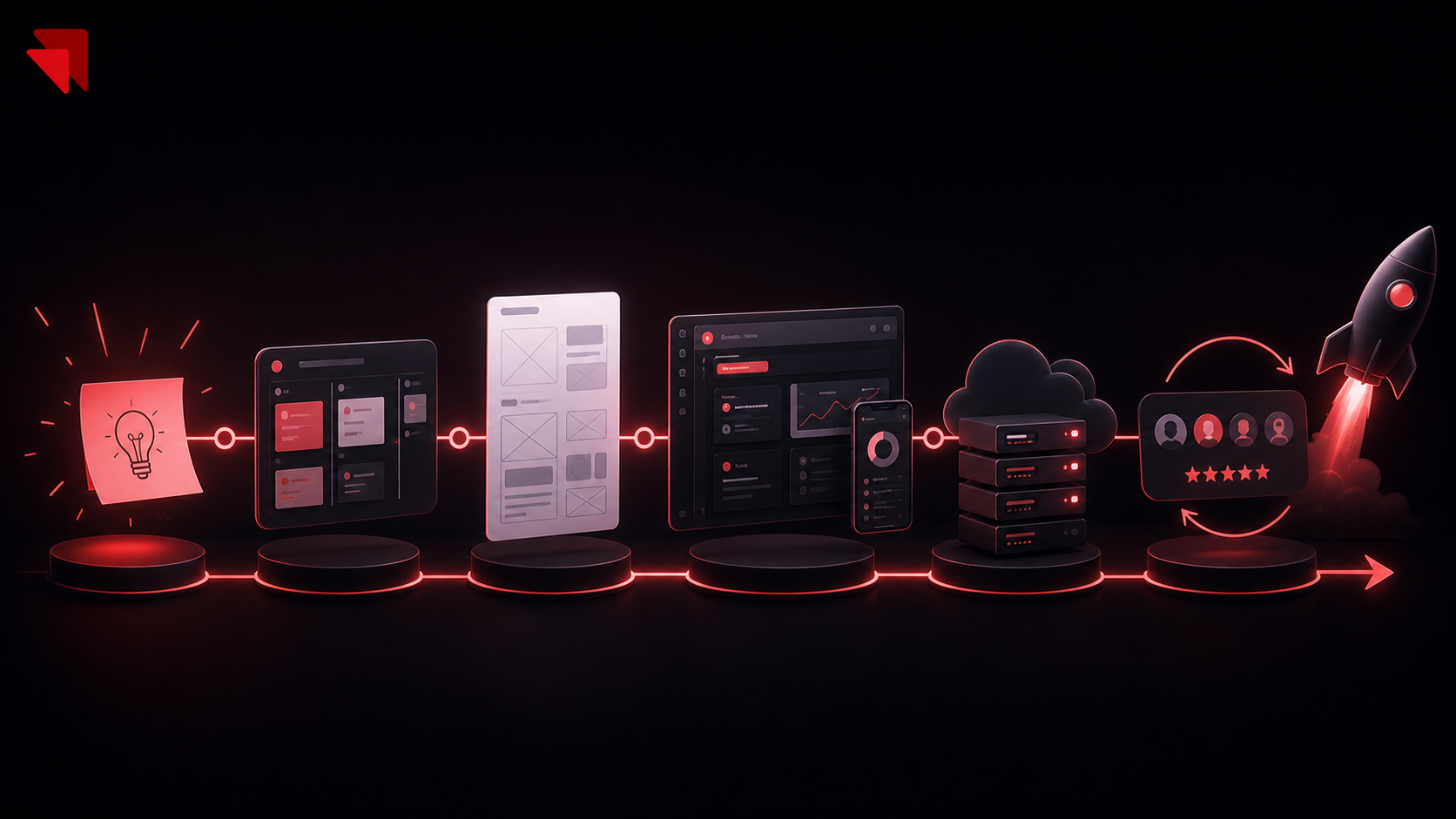
AI coding tools can generate code, but launching a product is not only about code.
A real product needs clear scope, user experience, reliable engineering, deployment, hosting, and a feedback loop.
1. Clear scope
Most early-stage products fail before development starts because the first version is too broad.
A founder may want a dashboard, onboarding, payments, admin panel, AI feature, notifications, analytics, and user roles all at once.
An AI coding tool can help build pieces of that. But it will not always tell you what should be removed, simplified, or delayed so the product can launch faster.
A good first product needs focus.
Not every idea deserves to be in version one.
A software engineering review of MVP practices found that MVP evaluation often depends on end-user validation through usability testing, A/B testing, and usage-data analysis. That supports the core point: a minimum viable product is not just a smaller product. It is a learning vehicle.
If you are still comparing build workflows, Replit vs Vibe Coding: Which Builds Faster for Startup MVPs is a useful internal comparison.
2. User experience that makes sense
A product can technically work but still feel confusing.
Founders often underestimate how much UX matters in the first launch. Users need to understand what the product does, where to click, how to complete the main action, and why they should continue using it.
AI tools can generate screens. But screen generation is not the same as product experience.
You still need someone to ask:
- Is this flow simple enough?
- Does the user understand the value quickly?
- Are there too many steps?
- Is the first product solving the core problem?
- Does the interface feel credible enough for early users?
Without that layer, a founder can end up with a product that looks finished but does not convert.
3. Reliable engineering decisions
AI-generated code can be fast, but founders still need the product to be stable.
The product needs the right database structure, API logic, authentication, deployment setup, error handling, and basic security decisions.
A prototype that breaks during a demo can hurt trust.
A product that cannot be maintained after launch becomes expensive later.
This is where engineering judgment matters. Founders do not just need code. They need code that can survive real usage.
The trust gap is real. The Stack Overflow Developer Survey 2025 reported that 46% of developers distrust AI-output accuracy, while only 3.1% highly trust it. The Google Cloud DORA 2025 report announcement also noted that while 90% of tech professionals use AI at work and more than 80% report productivity gains, 30% still report little or no trust in AI-generated code.
So yes, tools can speed the first draft.
But founders still need the review layer that catches reliability, maintainability, security, and architectural risk.
If your product includes AI features, the engineering requirement becomes even more important. You may need help with model integration, data flow, backend architecture, testing, and infrastructure. For a deeper look at what that support can involve, see Emveep’s guide on how to hire AI engineers for your startup.
4. Deployment and hosting
Many AI coding tools stop around the code generation stage.
But after code is generated, the founder still needs to answer:
- Where will this be hosted?
- How will the database run?
- How will the frontend connect to the backend?
- How will environment variables be managed?
- How will bugs be monitored?
- What happens when users start testing it?
This is often where non-technical founders get stuck.
The product exists locally, but it is not truly launched.
Deployment quality matters. Google Cloud’s DORA State of DevOps research shows a major gap between elite and low-performing software teams: elite teams deploy on demand or multiple times per day and have lead times of less than one hour, while low performers deploy less than once every six months and can take more than six months to move changes into production.
Generated code alone does not move a founder to the better side of that curve.
Hosting, environments, release hygiene, monitoring, and recovery practices still matter.
A founder does not just need a generated app. The founder needs a product that can be accessed, tested, and improved by real users.
5. Feedback and iteration
The first version of a product is not the finish line.
It is the start of learning.
After launch, founders need to see how users react. Which features do they use? Where do they get confused? What should be improved? What should be removed?
AI coding tools can help make changes, but they do not automatically turn feedback into a better product roadmap.
That matters because the biggest startup risk is not simply slow coding. According to CB Insights’ startup failure analysis, 43% of failed startups cited poor product-market fit, while 70% ran out of capital.
That is the core founder risk.
The biggest mistake is rarely:
“We coded too slowly.”
It is usually closer to:
“We learned too late.”
That is why founders need more than code generation.
They need a launch system.
What an “Easy Button” for Startup Product Launch Should Include
A real AI coding tool alternative for founders should not simply give you another dashboard, prompt box, or editor.
It should reduce the number of things you need to manage.
An easier launch path should include product scope, UX flow, full-stack development, hosting, and a feedback loop.
Product scope
Before anything is built, the idea needs to become a clear first version.
That means identifying the core user, the main problem, the first workflow, and the smallest useful product that can be launched quickly.
The goal is not to build everything.
The goal is to build the right first thing.
The academic paper MVP Explained: A Systematic Mapping Study on the Definitions of Minimum Viable Product found recurring emphasis around a minimum set of features, customer feedback, and minimum effort. That is exactly why scope discipline matters.
UX and product flow
The first product should be easy to understand.
Users should know what the product does, how to use it, and what value they get from it.
This requires product thinking, not just code generation.
Full-stack development
A founder should not need to manually connect multiple tools just to get a working product.
A proper launch service should handle frontend, backend, database, authentication, and core product logic together.
Hosting and launch setup
A product is not launched until users can access it.
That means deployment, hosting, domain setup, environment configuration, and basic production readiness should be part of the process.
If you are planning a more advanced AI product, you may also want to read Emveep’s article on how to build an AI product for your startup. It gives more context on what happens beyond simply creating a prototype.
Feedback loop
After the first build, the founder needs to validate the product.
That means collecting early feedback, identifying what users care about, and deciding what to improve next.
The best product launch path does not stop at:
“Here is your code.”
It helps you get to:
“Here is your product, live and ready to test.”
That is the real “easy button” founders are searching for.
How Emveep Vibe Helps Founders Launch Without Tool Overload
Emveep Vibe is not positioned as another AI coding tool founders must learn and operate.
It is a done-for-you product launch path for founders who want to move from idea to first working product faster.
Instead of asking founders to manage prompts, code, deployment, and debugging alone, this approach helps handle the first build end to end.
That includes:
- Turning your idea into a focused product scope
- Planning the first user flow
- Building the first version of the product
- Setting up hosting
- Helping you launch
- Supporting early validation and iteration
This is useful for founders who already know what they want to test but do not want to spend weeks comparing AI coding tools, learning technical workflows, or managing fragmented development tasks.
If you are comparing this path with other done-for-you or platform-based MVP solutions, this article on the best alternative to Builder.ai for startup MVPs is a useful next read.
AI Coding Tools Are Useful, But Founders Need Outcomes
This is not an argument against AI coding tools.
AI coding tools are useful. They can speed up development, reduce repetitive work, and help teams move faster.
But tools are only helpful when the person using them has the time, context, and technical confidence to operate them well.
The data supports both sides of the argument. The Stack Overflow Developer Survey 2025, GitHub’s 2024 AI coding research, McKinsey’s research on generative AI and developer productivity, and the Google Cloud DORA 2025 report announcement all point toward high adoption and meaningful productivity gains.
But other research shows why productivity is not the same as outcome.
The BCG report “Where’s the Value in AI?” found that only 22% of companies had moved beyond proof-of-concept to generate some AI value, and only 4% were creating substantial value. In another report, BCG’s “From Potential to Profit with GenAI” found that 90% of leaders were still either waiting for GenAI to move beyond the hype or experimenting in small ways.
That is the key distinction.
AI activity is not the same as product progress.
Many founders do not want to become part-time developers. They want to validate a business idea. They want to show a product to potential users. They want to test demand. They want to launch before momentum disappears.
For that kind of founder, the real value is not in owning another tool.
The real value is getting the first product live.
If you are still deciding whether to build with internal developers, staff augmentation, or an agency-style partner, this breakdown of AI development models: in-house, staff augmentation, and agency can help you compare the trade-offs.
When You Should Use an AI Coding Tool
An AI coding tool may be a good fit if:
- You are technical enough to review and fix code
- You enjoy building the product yourself
- You already understand deployment
- You have time to test, debug, and iterate manually
- You want direct control over every technical decision
In this case, AI coding tools can be a strong productivity multiplier.
They are especially useful when you already know what you are building, how the architecture should work, and how to take the product from local development to production.
When You Should Choose an AI Coding Tool Alternative
An AI coding tool alternative may be better if:
- You are a founder focused on business validation
- You want a working product, not just generated code
- You do not want to manage multiple technical tools
- You need help turning an idea into a clear first version
- You want the product hosted and ready for real users
- You prefer speed, guidance, and execution over learning another platform
This is where a product launch service can be a better fit than another AI coding tool.
Instead of asking you to operate the build process yourself, the right partner helps you clarify the first version, build it, host it, and get it ready for real users.
For founders building AI products specifically, Emveep’s AI Startup Development Company page also explains how Emveep helps founders move from discovery to MVP and v1 with clearer timelines and less technical uncertainty.
The Founder’s Real Job Is Not to Code Everything
A founder’s job is not to master every new AI coding platform.
A founder’s job is to find a real problem, understand the customer, test the solution, and build a business around it.
Technology should support that mission, not distract from it.
If an AI coding tool helps you launch faster, use it.
But if the tool creates more decisions, more setup, more debugging, and more uncertainty, it may not be the right path.
Founders do not need more complexity disguised as productivity.
They need a simpler way to move.
Launch First. Learn Faster. Build Better.
The first version of your product does not need to be perfect.
It needs to be real enough for users to try.
Instead of spending weeks choosing between AI coding tools, founders can start with the outcome that matters most:
A product in users’ hands.
The evidence points in the same direction. CB Insights’ startup failure analysis shows that product-market fit and capital efficiency are major failure factors. The MVP systematic mapping study shows why minimum features and customer feedback matter. Google Cloud’s DORA research shows that reliable delivery is a systems capability, not just a coding activity. And the BCG report on AI value shows that experimentation does not automatically become business value.
Put together, the message is simple:
The first product does not need to be fully mature, but it does need to be focused, live, and close enough to users to teach you something important.
Start Your First Product With Emveep Vibe
Most founders do not need another AI coding tool.
They need a clear path from idea to launch.
If you are ready to turn your idea into a working first product, start your free trial.
FAQ
What is an AI coding tool alternative?
An AI coding tool alternative is a more outcome-focused way to build software. Instead of giving founders another tool to operate, it helps them move from idea to working product through scope planning, design, development, hosting, and launch support.
Is Emveep Vibe an AI coding tool?
Emveep Vibe is not positioned as just another AI coding tool. It is a done-for-you product launch path for founders who want to build and launch their first product faster.
Who is this type of product launch service for?
It is for startup founders, business owners, and entrepreneurs who have a product idea but do not want to manage the full technical process alone.
Can non-technical founders use this approach?
Yes. A launch service approach is especially useful for founders who want help turning an idea into a working product without needing to personally handle code, deployment, hosting, and technical setup.
Why not just use an AI coding tool myself?
You can use an AI coding tool yourself if you are comfortable managing product scope, UX, code quality, deployment, testing, and iteration. But if you want a guided launch path that focuses on the final outcome, a product launch service may be a better fit.
What should an AI coding tool alternative help with?
It should help with the first product build, including idea clarification, scope, user flow, development, hosting, launch, and early validation support.
Is this good for MVP development?
Yes. This approach is especially useful for founders who want to launch a focused first version of their product and test it with real users before investing in a larger build.
Related Articles
See more articlesWeb Development
React Js DevelopmentNode Js DevelopmentVue Js DevelopmentNext Js DevelopmentLaravel DevelopmentPython DevelopmentRuby on Rails DevelopmentJava Spring Boot DevelopmentGolang Development.NET DevelopmentHave a question regarding your next project?
If you have any question about us or your next project, don't hesitate to contact us by chat or email.
info@emveep.com