
Founders often ask the same question when they are ready to build: should this become an MVP or just a prototype first?
The better question is slightly different: what needs to be validated next?
If the goal is to check whether people understand the idea, a clickable prototype may be enough. If the goal is to see whether potential customers will sign up, submit data, request access, complete a workflow, or share feedback after trying the product, a live prototype is usually more useful.
A full MVP becomes valuable when the problem, target audience, and core workflow are already clear enough to justify deeper product investment. But before reaching that stage, many early-stage founders need something smaller: a hosted version that works, feels real, and helps the team collect feedback from actual usage.
That distinction matters because building too much too early is one of the easiest ways to waste time and budget. CB Insights analyzed 431 VC-backed startup shutdowns since 2023 and found that poor product-market fit appeared in 43% of failures, while running out of capital appeared in 70% of cases. In other words, many startups do not fail simply because they cannot build. They fail because the market does not respond strongly enough before money runs out.
This guide explains the difference between an MVP and a live prototype, when a clickable demo is not enough, and why a small live first version is often the smarter move for validation.
For more context on AI-assisted product building, read What Is Vibe Coding for Startups?.
What Is an MVP?

An MVP, or minimum viable product, is the simplest usable version of a product that helps a team validate whether an idea creates real value.
It is not a cheaper version of the final product. It is not a half-finished app with every planned feature squeezed into a smaller budget. A good MVP is intentionally focused. It exists to test the core business assumption with early adopters.
Atlassian defines an MVP as the most basic product version that includes only the core features needed to satisfy early adopters and validate a product idea in the market. The main goal is to launch quickly, gather real feedback, and use those insights to guide the next development decisions.
For a startup founder, an MVP usually makes sense when the problem is already clear and the team needs to test whether the solution can become a real product. At this stage, the build may include essentials such as authentication, a dashboard, payment logic, integrations, notifications, admin tools, or user roles.
But those features should only exist if they help validate the product.
A payment flow belongs in the MVP if willingness to pay is the riskiest assumption. An admin panel makes sense if the operations team needs to manage real customer activity. A dashboard is useful when the main value depends on reporting, visibility, or decision-making.
The mistake is treating an MVP as “version one of everything.”
A stronger approach is to ask: what is the smallest product that can prove this is worth building further?
What Is a Live Prototype?

A live prototype is a smaller, hosted version of a product that real people can open, try, and respond to.
It is more functional than a clickable Figma demo, but narrower than a full MVP.
A clickable prototype shows how the product might work. A live prototype lets the first testers experience one real workflow. It may not include full automation, complex permissions, advanced integrations, or a polished backend, but it should be good enough to create meaningful feedback.
For example, a live prototype could be:
- A SaaS dashboard that displays one valuable report.
- An AI tool that accepts one type of input and returns one useful output.
- A marketplace request form connected to a basic operator dashboard.
- A booking flow that moves from landing page to confirmation.
- An internal tool that helps a team complete one repetitive task faster.
- A customer portal where prospects can submit information and receive a response.
The key is not feature count. The key is real interaction.
A live prototype should be deployed, shareable, and testable. It gives a startup team a working link that can be sent to prospects, early adopters, investors, internal stakeholders, or potential design partners.
Maze explains that prototype testing helps teams validate concepts and designs before investing heavily in development. The point is to identify problems earlier, learn from real interaction, and make better decisions before the product becomes more expensive to change.
That is exactly where a live prototype becomes useful. It helps founders move from “people said the idea is interesting” to “people actually tried to use it.”
MVP vs Prototype: What Is the Real Difference?
The easiest way to understand the difference is this:
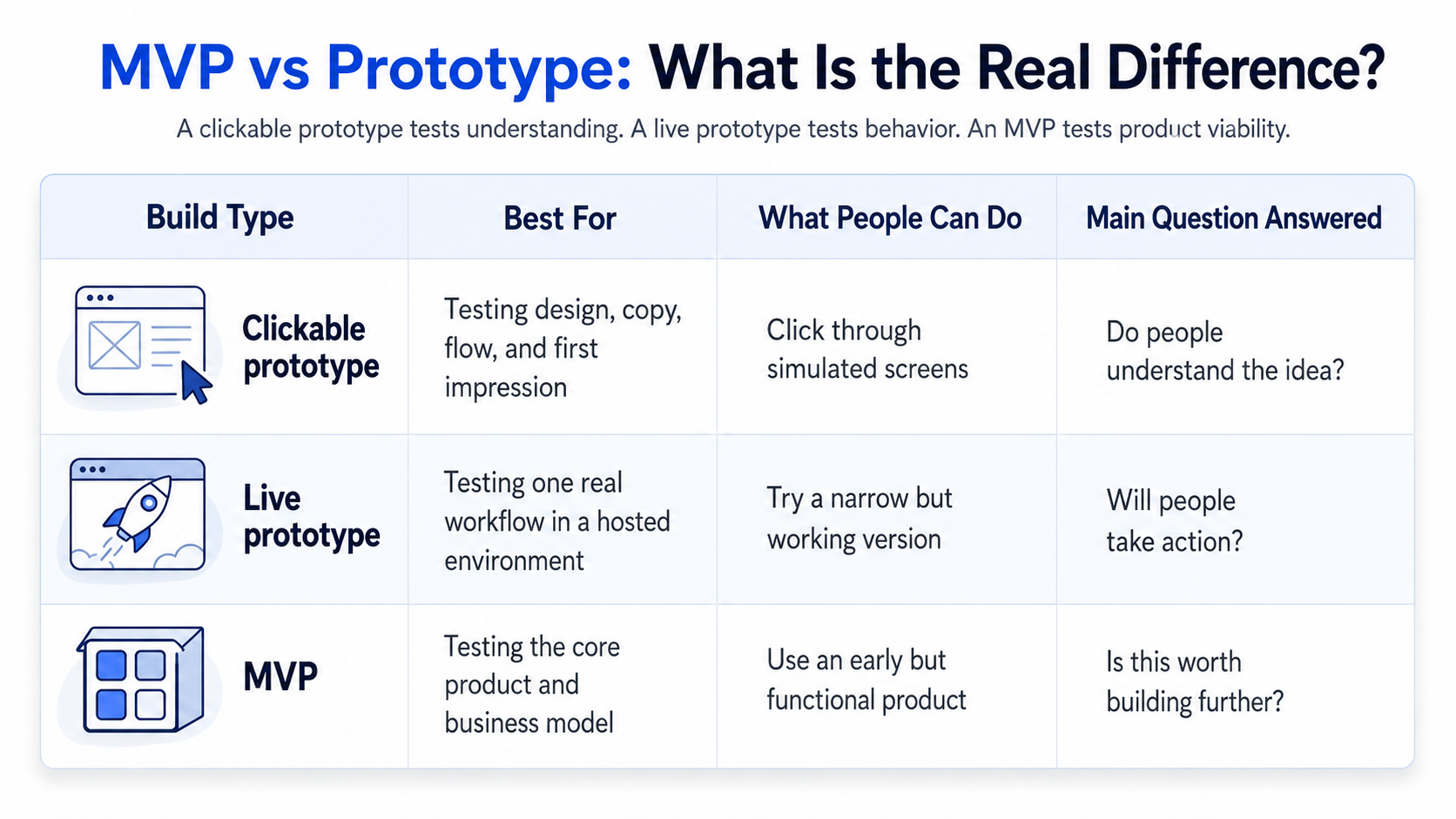
A clickable prototype tests understanding. A live prototype tests behavior. An MVP tests product viability.
A clickable prototype is usually created in a design tool. It may look polished, but most of the experience is simulated.
A live prototype is different because the experience exists outside the design file. A prospect can open a real link, enter information, complete a task, request access, upload something, or test a narrow workflow.
An MVP goes further. It is built to validate whether the product can become a real business. Compared with a live prototype, it usually needs stronger product structure, better technical foundations, more reliable data handling, and clearer operational workflows.
Many founders skip the middle step. They move from idea to MVP before knowing whether the core action matters.
That is risky.
A smaller live prototype can reduce that risk by giving the team enough proof before committing to a larger build.
When Is a Clickable Demo Not Enough?
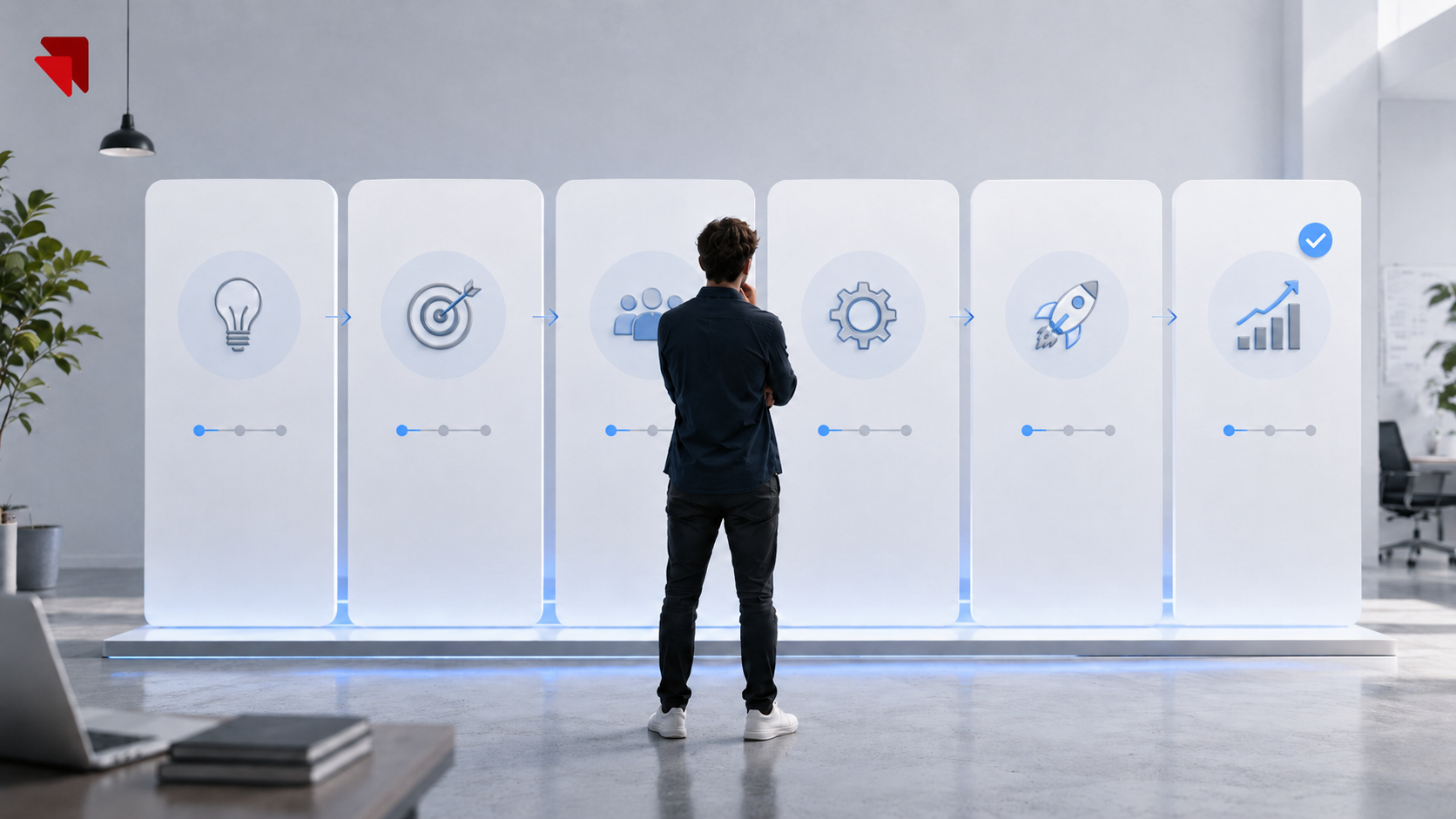
A clickable demo is helpful when the main goal is clarity.
It can answer questions like:
- Can the concept be understood quickly?
- Does the landing page explain the value clearly?
- Is the navigation easy to follow?
- Do the screens match the expected workflow?
- Are the product messages strong enough for early conversations?
But a clickable demo becomes limited when the team needs behavioral evidence.
For example, a founder may need to know whether a prospect will create an account, upload company data, request a demo, complete onboarding, invite a teammate, submit a booking, or return after the first session.
Those signals are difficult to measure from a static or semi-static prototype.
A design may look convincing in a pitch call. A clickable flow may feel smooth during a guided demo. But real validation starts when someone interacts with the product without the founder explaining every step.
Adobe notes that high-fidelity prototypes often look and function close to the real product, making participants more likely to behave naturally during usability testing. But when the test depends on actual data, backend response, workflow completion, or live access, a hosted prototype gives the team a stronger signal.
Consider an AI hiring tool.
A Figma demo can show the intended flow: upload a job description, generate a shortlist, review candidates, and export results. But the real question is whether a hiring manager trusts the output enough to use it.
That requires more than clickable screens.
A live prototype can accept a real job description, produce a sample result, and reveal whether the output feels useful. The founder can then observe what happens: Does the hiring manager read the result? Do they edit it? Do they ask for another run? Do they share it with a colleague?
Those signals are much more valuable than polite feedback.
Why a Smaller Live Prototype Often Comes Before an MVP
Founders often overbuild because they confuse product maturity with product validation.
They believe the first release must look complete before anyone can test it. As a result, the team may spend months building advanced settings, multi-role dashboards, billing, onboarding, integrations, notifications, analytics, and edge cases.
But early validation usually does not require all of that.
It requires one valuable outcome.
A smaller live prototype helps focus the build around the first real proof point. The team can learn whether the target audience understands the offer, completes the main action, receives value from the output, gets stuck in the workflow, or asks to try it again.
This matters because late changes are more expensive than early changes. IBM’s software quality material, referencing NIST, shows that defects found after release can cost up to 30 times more to fix than issues caught during the design and architecture phase.
The lesson for founders is simple: the earlier a team learns what is wrong, the cheaper it is to adjust.
A live prototype creates that learning before too much budget is locked into the wrong product direction.
This is also why founders should be careful with generic AI coding tools. Speed helps, but speed without scope can turn into messy product decisions. For a deeper explanation, read Most Founders Do Not Need Another AI Coding Tool.
What Should You Build First?
The right first build depends on the stage of the idea.
Build a clickable prototype first when the idea still needs shape
A clickable prototype is useful when the concept, flow, or positioning is still unclear.
This stage is ideal for exploring navigation, copy, page structure, and first impressions. A founder can use it for customer interviews, investor conversations, internal alignment, and early product discussions.
At this point, the build does not need to be live. The main job is to make the idea easier to understand.
Build a live prototype first when behavior needs to be tested
A live prototype is the better choice when the core workflow is already clear, but the founder still needs real-world evidence.
This works well when the next question is not “do people understand this?” but “will they actually do something with it?”
A hosted prototype can test signups, uploads, submissions, requests, generated outputs, bookings, internal workflows, or basic dashboard usage. The product team gets feedback from real interaction, not only from opinions.
For many early-stage founders, this is the best first build.
Build an MVP first when validation is already strong
An MVP makes sense when the startup has enough evidence that the problem matters and the proposed solution deserves a more serious product investment.
At this stage, potential customers may already be asking for access. A design partner may be ready to test the first product version. The founder may need to prove retention, willingness to pay, operational feasibility, or repeat usage.
Compared with a live prototype, the MVP needs more structure. It should be stable enough to support real early customers and detailed enough to guide the next product roadmap.
If the comparison is between AI-assisted MVP options, read Best Alternative to Builder.ai for Startup MVPs.
A Simple Founder Decision Framework
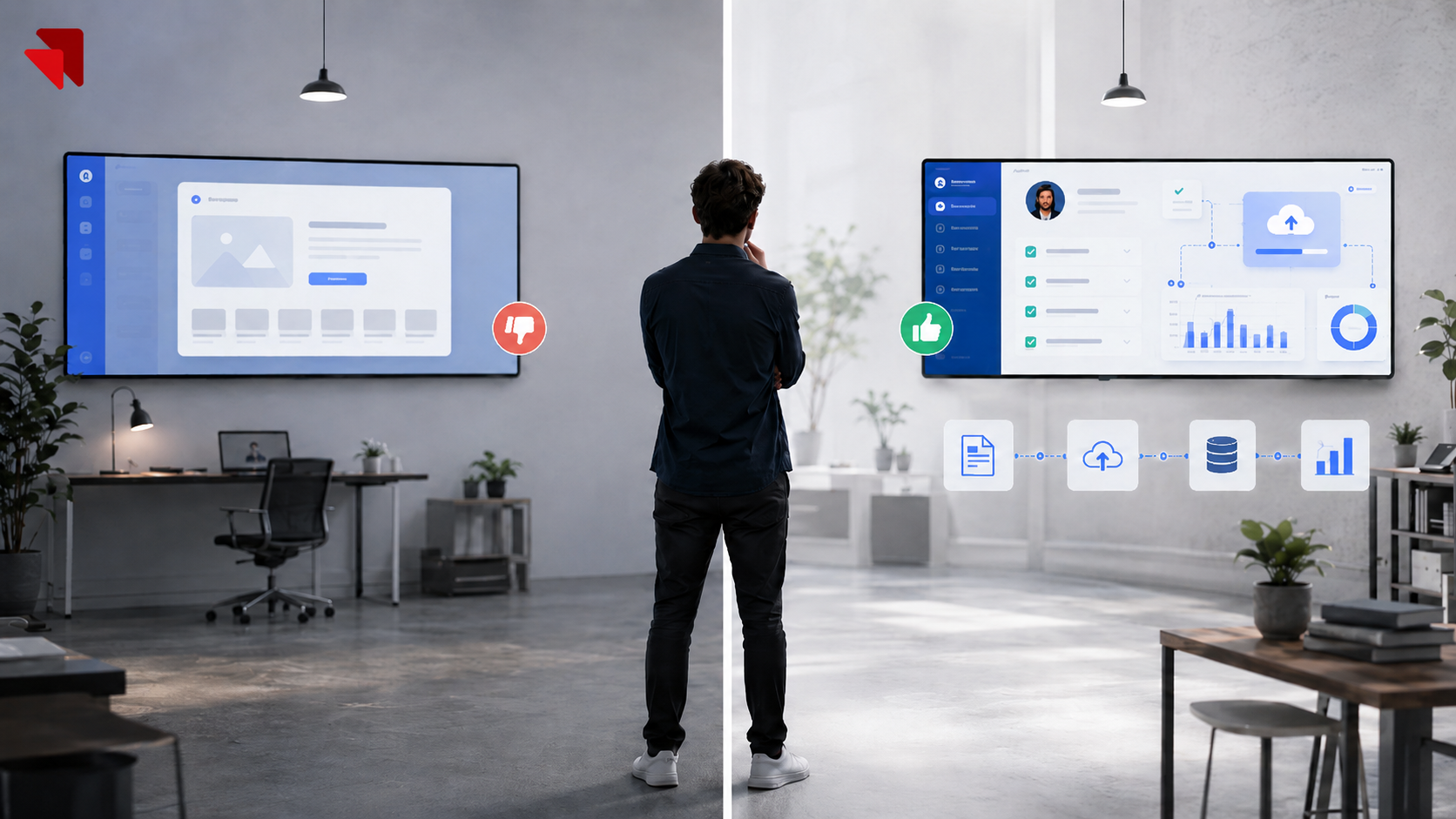
Before deciding between an MVP and a live prototype, use this framework.
1. Start with the riskiest assumption
Every early build should answer one important question.
For example, the riskiest assumption might be that a company will trust an AI-generated recommendation, a team will replace a spreadsheet with a new dashboard, a buyer will submit a marketplace request, or an operator will use the tool every morning.
When the assumption is clear, the scope becomes easier to control.
2. Define the smallest proof of interest
A compliment is not strong validation. “This looks interesting” is useful, but it does not prove demand.
Stronger signals include an email signup, a demo request, a completed form, an uploaded file, a repeated session, a payment conversation, a referral, or a request to use the product again.
The first build should make those signals easy to capture.
3. Choose the right level of realism
Some ideas only need a visual walkthrough. Others require a real environment.
If the goal is to test messaging, a clickable prototype may be enough. If the workflow depends on input, output, data, automation, or completion, a live prototype is more reliable. If the product must support repeat usage and business operations, an MVP is more appropriate.
4. Keep some operations manual at first
The first version does not need to automate everything.
A founder can manually review submissions, trigger reports, approve requests, prepare outputs, qualify leads, or process data behind the scenes.
Manual work is not a failure at this stage. It is a validation shortcut.
The team can learn whether the result matters before investing in full automation.
5. Make the build lead to a decision
A first build should not exist just to look impressive.
It should help the founder decide whether to continue, change the target audience, rewrite the positioning, simplify the workflow, add automation, start charging, or stop the idea.
If the build does not support a decision, the scope is probably too vague.
What Should Be Included in a Live Prototype?
A strong live prototype should feel useful without becoming bloated.
The first version may include a landing page, a focused signup flow, one core workflow, a basic output page, a simple dashboard, a lightweight admin view, feedback collection, and a shareable link.
For an AI product, the prototype might include one input format, one AI-assisted output, and a simple way to review the result.
For a marketplace, the first version may only need request submission, basic matching, and manual follow-up.
For an internal tool, the starting point could be a simple dashboard that replaces one recurring spreadsheet process.
What should usually wait?
Advanced role management, full billing systems, complex integrations, multi-step automation, large dashboards, mobile and web apps at the same time, and edge cases that only matter after scale.
The goal is not to prove that the product can do everything.
The goal is to prove that one core workflow is worth expanding.
How Emveep Vibe Scopes the First Version
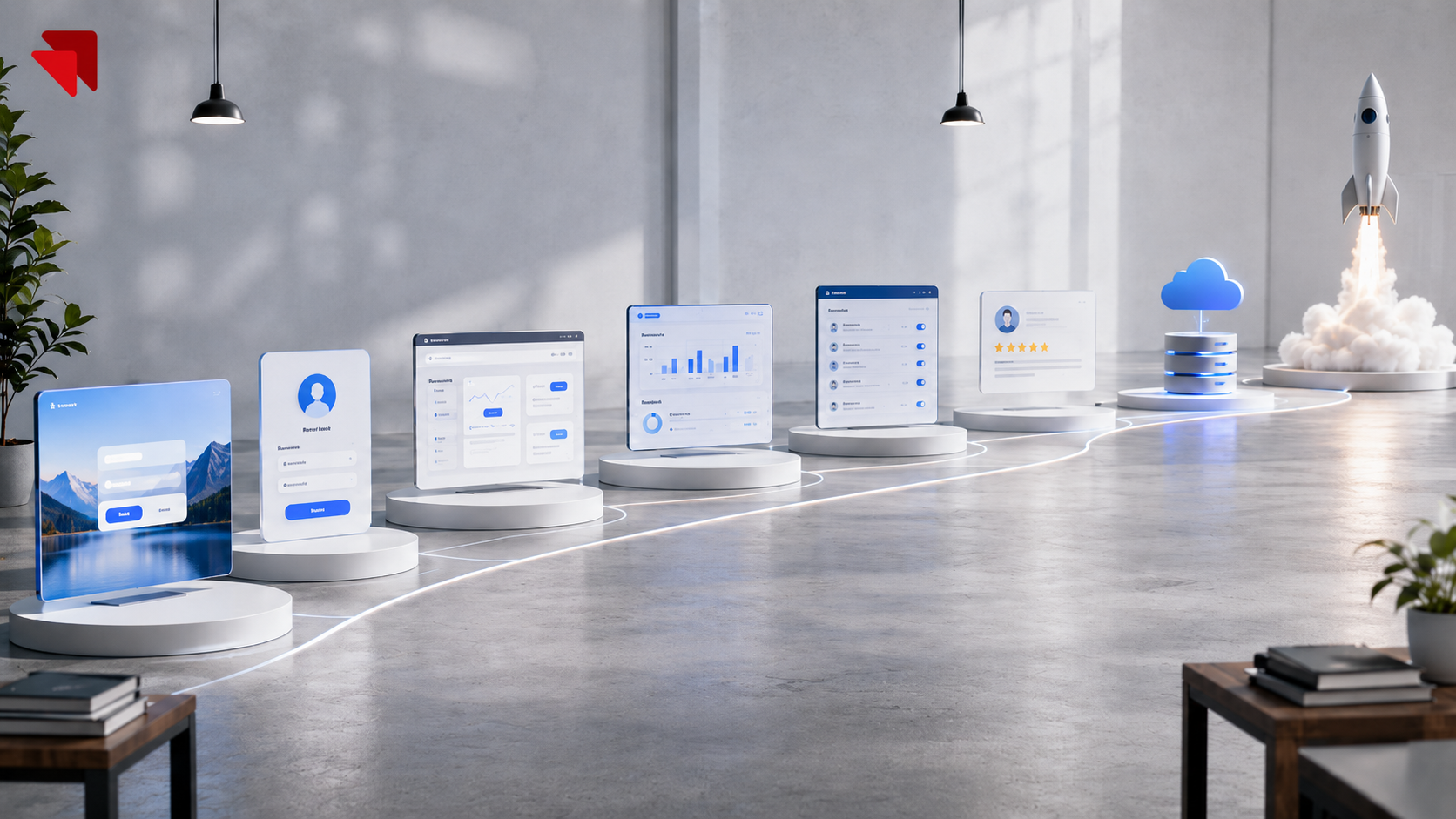
Emveep Vibe is designed for founders who want to validate a product idea without overbuilding the first release.
Instead of giving founders another AI coding tool to operate alone, Emveep Vibe helps turn an idea into a focused MVP, web app, SaaS prototype, or internal tool. The first version is scoped around a specific workflow, built with AI-assisted speed, reviewed by human product and engineering experts, deployed live, and hosted free for 30 days. The Vibe page states that eligible founders can get a focused MVP, web app, SaaS prototype, or internal tool built in an estimated 14–30 days, with free hosting for 30 days after launch. (Vibe Emveep)
That structure matters because most founders do not only need code.
They need help deciding what belongs in version one, what should be removed, what must be real, what can stay manual, and what feedback should be collected after launch.
This is where a live prototype becomes practical.
It helps avoid two common traps.
The first trap is building a beautiful demo that cannot test real behavior.
The second trap is building a full MVP before the product direction is clear.
Emveep Vibe sits between those extremes. It helps a founder launch something small, hosted, and ready for feedback, so the next product decision is based on real usage instead of assumptions.
If the product idea is already clear and the next step is to put a focused first version in front of real people, start with Build a Free Trial Prototype.
What Comes After the Live Prototype?
A live prototype should create learning, not just a launch moment.
After the first testers try it, the founder should review what actually happened.
- Did prospects understand the promise?
- Was the main workflow completed?
- Where did people hesitate?
- Which step created confusion?
- Did the output feel valuable?
- Was there any buying intent?
- Did anyone ask for another session?
- Did the feedback point toward a clearer MVP scope?
Weak signals do not always mean the idea is bad. Sometimes the positioning is unclear. Sometimes the wrong audience was tested. Sometimes the workflow is too heavy. Sometimes the product needs a narrower use case.
Strong signals, on the other hand, can justify a proper MVP.
That is when the team can add stronger architecture, improved UX, payments, integrations, permission layers, dashboards, onboarding, analytics, and operational tools.
For founders building AI products, the next stage may also require better data design, AI workflow testing, model evaluation, security planning, and production readiness. For more detail, read How to Build an AI Product for Your Startup: A Complete Guide.
If the founder wants a broader support model for product validation and execution, Partnership with a Startup Studio for a Successful Startup is another relevant follow-up.
MVP vs Live Prototype: Which One Should Founders Build First?
For most early-stage founders, the best first build is a small live prototype.
Not because MVPs are bad. MVPs are valuable when the direction is already validated. But when the goal is fast feedback, a full MVP may be more than the product needs.
A live prototype gives the team a better signal than a clickable demo while staying smaller than a full product build. Early adopters can open a real link, complete a focused workflow, and provide feedback based on actual interaction.
That is the practical middle ground.
The founder gets something real enough to test, but lean enough to change.
The product team gets usage signals before committing to a larger roadmap.
Potential customers get a working experience, not just a presentation.
The smartest first build is not the biggest version the team can afford. It is the smallest live version that can answer the next important question.
If that question is “will people actually use this?”, start with a live prototype.
If the answer is strong, the MVP will be easier to scope, easier to justify, and much easier to build in the right direction.
Ready to validate your idea with a focused first version? Start with Build a Free Trial Prototype.
FAQ
Is a prototype the same as an MVP?
No. A prototype usually tests the concept, design, or flow. An MVP is a working early product that helps validate whether the solution creates real value. A live prototype sits between the two: smaller than an MVP, but more realistic than a clickable demo.
Should founders build a prototype before an MVP?
In many cases, yes. If the idea, flow, or user behavior still needs validation, a prototype should come first. A clickable prototype can test understanding. A live prototype can test action. An MVP is better once the team has enough evidence to build a more complete first product.
What is a live prototype?
A live prototype is a hosted, shareable version of a product that lets people try one meaningful workflow. It does not need every feature, but it should be real enough to collect feedback from actual usage.
When is a clickable prototype not enough?
A clickable prototype is not enough when the team needs to test real behavior, such as signups, uploads, form submissions, booking requests, AI output quality, repeat usage, or payment intent.
What should be included in a startup prototype?
A startup prototype should include only what is needed to test the core assumption. This may include a landing page, signup flow, one main workflow, a basic dashboard, simple admin tools, and a feedback mechanism.
Should a live prototype have backend functionality?
Yes, if backend behavior is needed to validate the idea. The backend can be simple, manual, or semi-automated at first. The goal is not full scalability yet. The goal is to make the workflow real enough for feedback.
What should founders build first: MVP or live prototype?
If the idea is still unclear, start with a clickable prototype. If the workflow is clear but behavior needs validation, build a live prototype. If there is already strong proof of demand, move into an MVP.
Related Articles
See more articlesWeb Development
React Js DevelopmentNode Js DevelopmentVue Js DevelopmentNext Js DevelopmentLaravel DevelopmentPython DevelopmentRuby on Rails DevelopmentJava Spring Boot DevelopmentGolang Development.NET DevelopmentHave a question regarding your next project?
If you have any question about us or your next project, don't hesitate to contact us by chat or email.
info@emveep.com