At Emveep, we believe AI coding tools are one of the most useful shifts in startup product development.
They help founders move faster. They reduce the blank-page problem. They make early product ideas easier to visualize. With the right prompt, a founder can generate UI screens, backend logic, landing pages, database structures, and working prototypes in a fraction of the time it used to take.
That is a real advantage.
But after working with startups for years, we also see where founders get stuck.
Generated code is not the same as a launched product.
A generated app may run locally. A launched product can be opened by real users, tested in a real environment, reviewed for risk, improved through feedback, and used to validate whether the startup idea deserves more investment.
That gap matters.
According to the 2025 Stack Overflow Developer Survey, 84% of respondents are already using or planning to use AI tools in their development process. But the same survey also found that 66% of developers cite “AI solutions that are almost right, but not quite” as their biggest frustration.
From our point of view, that is exactly the founder’s challenge: AI can help you move fast, but “almost right” is not always launch-ready.
If you are still exploring the basics, read our guide on what vibe coding means for startups. This article focuses on what happens after the code is generated.
What Generated Code Gives You
Generated code is useful because it reduces the distance between idea and first version.
For founders, AI coding tools can help with:
- Creating a quick prototype
- Drafting frontend screens
- Generating backend logic
- Testing product concepts
- Exploring technical feasibility
- Reducing early development friction
- Moving faster before hiring a full team
We do not see AI coding as a gimmick. We see it as a powerful starting point.
For early-stage founders, this speed can change the entire rhythm of product exploration. An idea that used to stay in a pitch deck can become something visible. A concept that used to require long technical conversations can become a rough prototype. A founder who could not code can finally test product direction with something more concrete than slides.
But generated code is still only one part of the journey.
It may show what the product could become. It does not automatically make the product usable, secure, hosted, validated, or ready for customer feedback.
Generated Code vs Launched Product
From Emveep’s experience, this is the practical difference.
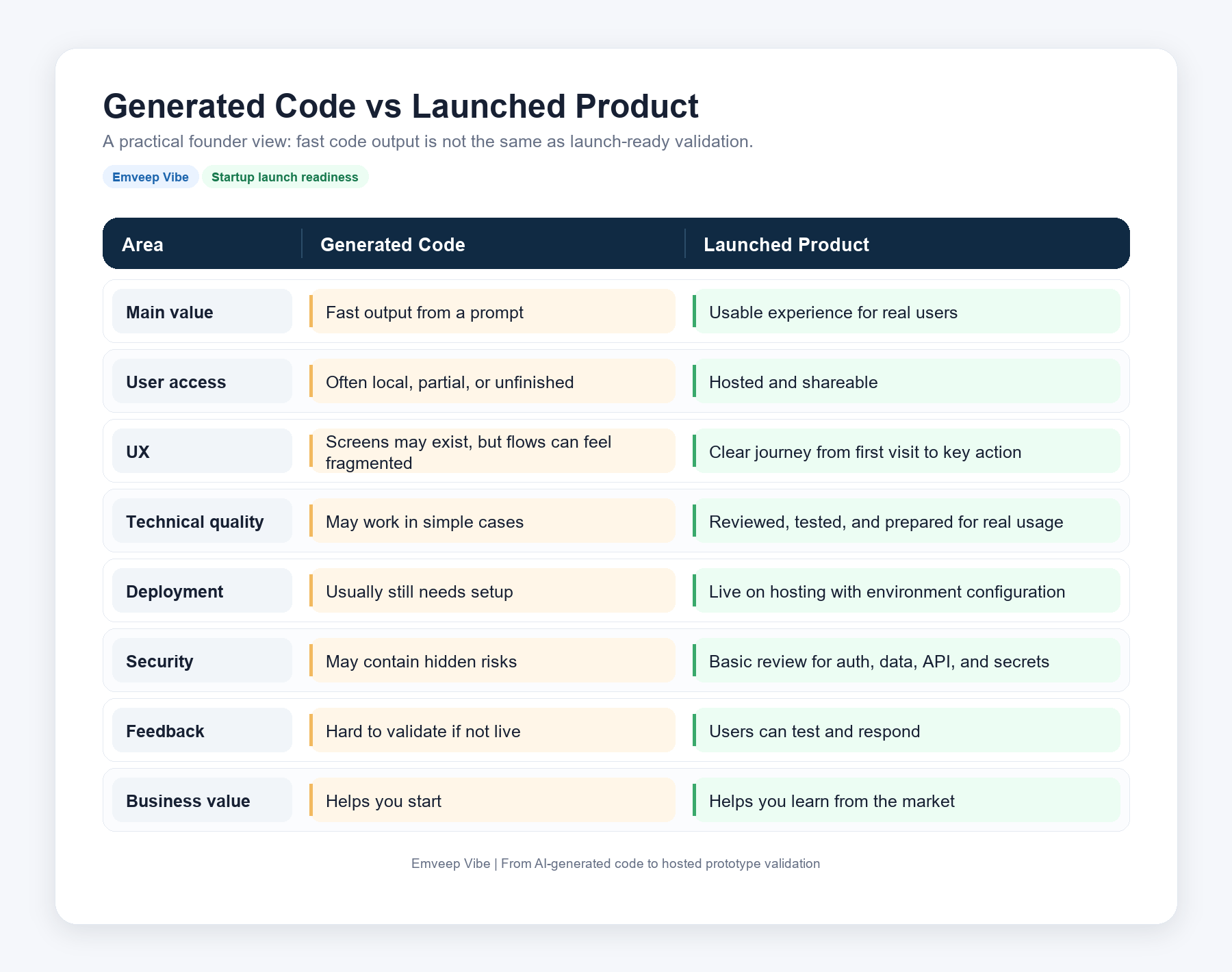
This is why we often say that most founders do not need another AI coding tool. They need a product path.
The problem is usually not that founders cannot generate code. The problem is that they do not yet have a clear bridge from code output to a product real users can try.
What Generated Code Does Not Solve
AI generated code can help you start faster, but it does not automatically solve the operational work around launch.
Founders still need to think about:
- Product scope
- User flow
- Design consistency
- Hosting
- Deployment
- Database setup
- Authentication
- Security review
- Error handling
- Analytics
- Feedback collection
- Iteration after launch
This is where Emveep’s role becomes different from an AI coding tool.
We are not here to compete with AI. We use AI where it helps. But we also bring product judgment, engineering review, UX thinking, deployment experience, and launch discipline into the process.
The goal is not just to produce more code. The goal is to help founders validate the right product faster.
If you are unsure what to build first, our article on MVP vs live prototype explains why founders often need something smaller, faster, and easier to validate before overbuilding.
UX Coherence Matters More Than Screens
AI tools can generate pages. But users do not experience your product as separate pages.
They experience a flow.
A founder may see generated code and think, “The dashboard is done.” But a user may still wonder:
- What should I do first?
- What problem does this solve?
- Why should I trust this?
- What happens after I submit the form?
- Did my action succeed?
- Where do I go next?
At Emveep, we look at generated products through this lens: can a real user understand what to do without explanation?
A generated UI can look polished while still feeling confusing. A launched product needs coherence: onboarding, empty states, success states, errors, navigation, and a clear path to value.
Good UX is not only about interface design. It is about reducing hesitation for the user.
Deployment and Hosting Are Part of the Product
A product is not launched until users can access it.
This is one of the biggest differences between generated code and a real startup prototype.
Local code may still need:
- Hosting setup
- Environment variables
- Domain configuration
- Database provisioning
- Build fixes
- API configuration
- Authentication setup
- File storage
- Monitoring
- Production testing
The Stack Overflow survey found that 75.8% of respondents do not plan to use AI for deployment and monitoring tasks. That tells us something important: even developers who use AI often treat deployment as a higher-responsibility workflow.
That matches what we see in real startup work.
Founders may have code, but they still need help making it live, stable, and shareable. Without that step, validation cannot happen. You cannot learn much from users if the product only runs in a development environment.
This is why Emveep Vibe includes hosting support. We want founders to get beyond “it works on my machine” and into “users can test this now.”
Security and Review Still Matter
Working code is not always safe code.
This becomes especially important when your product handles user accounts, payments, private data, business records, uploads, or third-party integrations.
Before launch, founders should review:
- Authentication
- Authorization
- API access
- Input validation
- Database permissions
- Secrets and environment variables
- Dependency risks
- Error handling
- Data storage
- Payment flows
DORA’s 2026 report on generative AI in software development found that a 25% increase in AI adoption was associated with a 1.5% decrease in delivery throughput and a 7.2% decrease in delivery stability. Their explanation is simple: AI can increase code volume quickly, which can make review, testing, and stability harder if teams do not improve their delivery process.
Our view is simple: AI speed is useful, but it should be paired with human review.
That does not mean every prototype needs enterprise-grade architecture. But even an early product should avoid obvious risks, especially if real users will interact with it.
For more on the risk side, read When Vibe Coding Goes Wrong.
Feedback and Iteration Make the Product Real
Generated code is a starting point. Feedback is what turns it into a product.
Once users interact with a live prototype, founders learn things that prompts cannot fully predict.
Users may:
- Ignore a feature the founder thought was important
- Misunderstand the onboarding
- Ask for a simpler workflow
- Find bugs in real usage
- Request integrations
- Validate the problem but reject the current solution
- Reveal which feature deserves more investment
This is why we push founders toward live validation as early as possible.
A useful product path looks like this:
- Define the smallest testable version
- Build a focused prototype
- Host it online
- Share it with target users
- Collect feedback
- Improve the product based on real usage
- Decide whether to scale, pivot, or stop
The point is not to build everything. The point is to learn what deserves to be built next.
If your product involves AI features, our guide on how to build an AI product for your startup is a good next read.
Why Founders Need a Product Path
The real opportunity is not AI versus developers.
The real opportunity is AI speed plus product execution.
This is the point of Emveep Vibe.
We help founders move from idea to hosted prototype by combining AI-assisted development with human product and engineering support. AI helps accelerate the build. Our team helps with scope, UX, architecture, review, launch readiness, hosting, and iteration.
That path includes:
- Scoping the MVP
- Creating a coherent UX
- Reviewing the code
- Preparing hosting
- Launching a shareable version
- Collecting feedback
- Iterating based on validation
A startup does not just need generated code. It needs a product users can open, understand, try, and respond to.
That is where real validation begins.
From Generated Code to Launched Product
AI generated code is powerful. It helps founders start faster than before.
But a launched product needs more than generated output. It needs UX coherence, deployment, hosting, security review, and a feedback loop.
From Emveep’s point of view, the future of startup development is not about removing humans from the process. It is about using AI to move faster while keeping experienced builders involved in the decisions that affect product quality.
If you are using AI coding tools and feel stuck between a promising prototype and a real launch, that gap is normal.
The next step is not to abandon AI. The next step is to turn AI output into a product path.
Let Us Build It Free
Have an idea or AI-generated prototype that is not ready to launch yet?
Let Emveep Vibe build it free and turn your idea into a hosted
Related Articles
See more articlesWeb Development
React Js DevelopmentNode Js DevelopmentVue Js DevelopmentNext Js DevelopmentLaravel DevelopmentPython DevelopmentRuby on Rails DevelopmentJava Spring Boot DevelopmentGolang Development.NET DevelopmentHave a question regarding your next project?
If you have any question about us or your next project, don't hesitate to contact us by chat or email.
info@emveep.com